Groundwater in East Champaran carries high iron content and elevated TDS levels, particularly in areas drawing from deep borewells. Monsoon season brings turbidity spikes that strain RO systems, while summer demand and well depletion create intermittent supply issues that affect how purifiers operate. An Eureka Forbes unit running continuously under these regional water conditions requires more frequent attention than units in areas with cleaner municipal supply.
Many households across Motihari and surrounding towns rely on Eureka Forbes purifiers as their primary defense against iron staining, mineral buildup, and seasonal water quality fluctuations. When these systems falter — whether from clogged filters, membrane strain, or pressure irregularities — finding a technician who understands the district's specific water chemistry becomes essential.
Select Service

.webp&w=256&q=75)
Everything you need to know
East Champaran's groundwater profile differs significantly from other parts of India. Iron-laden borewell water clogs sediment filters far faster than surface water does, and high mineral content accelerates membrane degradation. Households here often face a harder choice about maintenance than those in areas with softer water supplies. Putting off a filter change by even a month can mean the difference between a routine replacement and a situation where mineral buildup has already begun damaging the membrane itself.
When an Eureka Forbes purifier stops working during the pre-monsoon heat, replacement becomes urgent — and urgent means paying higher service charges and waiting in a queue behind dozens of other households facing the same problem. Preventive maintenance, by contrast, spreads costs across the year and ensures your purifier is functioning well before demand peaks.
The district draws from two main sources: municipal borewell-fed supply (in towns like Motihari) and private deep borewells (in rural areas and smaller towns). Each source carries different service implications for your Eureka Forbes system.
Town water typically undergoes basic chlorination and sedimentation but retains moderate to high iron and TDS. The advantage is relative consistency — seasonal fluctuations are less extreme than with private wells. An Eureka Forbes unit on municipal supply needs filter changes roughly every 4 to 6 months for pre-filters and 6 to 9 months for carbon filters, with membrane replacement every 18 to 24 months.
Deep groundwater in the district often contains dissolved iron (causing brown or yellow tinting), high hardness, and variable TDS readings depending on well depth and local geology. Units running on borewell water may need pre-filter and carbon filter changes every 3 to 5 months, and membrane lifespan can shorten to 12 to 18 months. The membrane bears a heavier load, so technician visits become more frequent.
July through September bring surface runoff, increased turbidity, and occasional silt in borewell recharge zones. Eureka Forbes purifiers operate under higher stress during these months, and many households find their units need urgent attention just as the service industry faces peak demand. Scheduling a pre-monsoon service in May or June avoids this congestion.
The water quality issues common in East Champaran create specific warning signs that shouldn't be ignored:
Not every technician has experience with the specific challenges East Champaran presents. When searching for Eureka Forbes RO service, ask these district-relevant questions before booking:
Do they understand high-iron water behaviour? A technician who has worked extensively with borewell-fed purifiers knows which filter grades work best for iron-heavy water and won't overcharge for unnecessary cleaning cycles. They can also advise whether your current Eureka Forbes model is ideally suited to your water source, or if a model upgrade might save money in the long run.
How do they handle seasonal demand? Reliable providers keep pre-monsoon appointment slots and understand why May and June bookings need priority over October slots. They also stock filters suited to post-monsoon water recovery challenges.
Can they diagnose TDS and hardness issues? A visit that includes a TDS test of the output water (not just the input) tells you whether your purifier is actually delivering water safe for consumption. Many households in the district don't realize their purifier has been letting dissolved salts through for months until a technician tests it.
Are they transparent about what Eureka Forbes model you have? The district has older purifiers still in use (Aquaguard Classic, Aquasure Smart) alongside newer hybrid models. A technician who confidently names your exact model and its specific membrane type before the visit is more reliable than one who arrives with generic parts.
Service pricing varies based on several factors specific to East Champaran's conditions and market:
An Annual Maintenance Contract makes particular sense for households in this district because of the region's aggressive water profile. Rather than absorbing multiple repair shocks across the year, an AMC spreads costs predictably and ensures preventive attention before problems escalate.
Four scheduled visits per year (aligned with seasonal water changes), replacement filters and membranes as needed, priority booking during peak demand periods, and emergency callout service for urgent breakdowns. Some plans also include one complimentary TDS test per visit, which is valuable for confirming water safety in high-mineral areas.
If you're running the purifier daily on borewell water, an AMC will almost certainly pay for itself compared to booking visits individually. Pre-monsoon and post-monsoon service spikes often involve wait times that can stretch 7-10 days — an AMC guarantees priority scheduling. For high-volume households (families of 5 or more, or small offices and clinics), the monthly cost of an AMC plan usually undercuts the equivalent pay-per-visit expense by the third or fourth service call.
If your purifier is still under manufacturer warranty (usually 12 months from purchase), an AMC may duplicate coverage. Also, if you use municipal supply water in Motihari town and your unit requires fewer than two service visits annually, individual payments might be cheaper than a full-year AMC commitment.
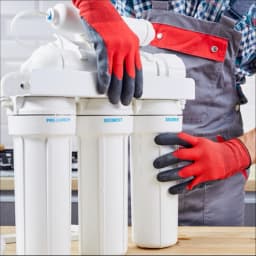
Understanding what each filter does and when to expect replacement helps you anticipate costs and avoid confusion during technician visits:
This filter captures sand, rust particles, and iron oxide from borewell water before they damage downstream components. In East Champaran, iron content typically requires replacement every 3 to 5 months rather than the standard 6-month interval used in low-iron areas. Delaying this replacement strains the carbon filter and membrane unnecessarily.
Removes chlorine, organic compounds, and unpleasant odors. It also helps trap some dissolved iron compounds. Expect replacement every 5 to 7 months in high-TDS conditions, compared to 6 to 8 months in softer-water regions. A failing carbon filter is why brown water sometimes flows from the tap even after an RO system is supposedly filtering.
The core of your purification system, pushing water through a semi-permeable barrier to remove dissolved salts and minerals. In East Champaran's mineral-heavy groundwater, membranes typically last 12 to 18 months instead of the advertised 24 months. This is not a manufacturing defect — it's simply the reality of your local water chemistry. Replacing a membrane costs more than filters but prevents bacterial contamination that can develop if you wait until the membrane completely fails.
This final stage improves taste by removing any residual odors. Replacement frequency mirrors the main carbon filter, around 5 to 7 months. It's not the most critical component, but skipping it affects water taste noticeably.
Knowing the steps involved helps you evaluate whether a technician is doing thorough work versus rushing through to collect payment:
East Champaran households sometimes face service issues that reflect the district's specific challenges:
Unnecessary membrane replacements. Some technicians recommend membrane changes when only filters need replacing, taking advantage of the fact that many homeowners don't understand their purifier's components. Request a TDS test to justify any major replacement before approving the work.
Using low-grade filter media unsuited to iron-heavy water. Cheaper filters don't trap iron particles effectively and wear out faster. Insist on filters graded for the water source your purifier actually receives, even if they cost slightly more per visit.
Ignoring seasonal water changes. A technician unfamiliar with East Champaran's water profile may not adjust service recommendations between dry season (high TDS) and post-monsoon (turbidity) conditions. A local expert adapts their approach to these fluctuations.
Skipping tank sanitization. Storage tanks in high-mineral areas accumulate scale and sludge faster. A thorough service includes tank cleaning; rapid or cursory visits might skip this, leaving contamination risks.
The Eureka Forbes customer care number provides access to warranty claims, product registration, and official service network information. For warranty-related issues — manufacturing defects, membrane failures within covered period, pump failures in the first 24 months — the official channel is worth pursuing, though response times during peak season can extend into weeks.
For routine maintenance (filter changes, tank cleaning, minor valve repairs), trained independent technicians in the district often respond faster than official channels and can arrange appointments within 24-48 hours. The distinction matters: warranty claims need Eureka Forbes authorization, but regular servicing doesn't. Many households keep both the official customer care contact and a trusted local technician's number, using each for the appropriate situation.
The mineral-heavy groundwater that makes Eureka Forbes purifiers essential in this district also means higher ownership costs compared to regions with softer water. A realistic annual maintenance budget for a household running an RO unit daily on borewell water should account for 4-5 service visits, multiple filter sets, and likely one membrane replacement within a 24-month window. Breaking this into monthly savings (roughly 500-800 rupees per month) helps many households plan for expenses that won't come as shocks.
An AMC plan, while requiring upfront payment, removes the uncertainty and often delivers 20-30% savings over paying per visit, particularly for households in rural areas where travel charges accumulate quickly. Whether you choose an AMC or individual bookings, committing to scheduled service is far cheaper than reacting to emergency breakdowns.
What makes us different
Groundwater in East Champaran carries high iron content and elevated TDS levels, particularly in areas drawing from deep borewells. Monsoon season brings turbidity spikes that strain RO systems, while summer demand and well depletion create intermittent supply issues that affect how purifiers operate. An Eureka Forbes unit running continuously under these regional water conditions requires more frequent attention than units in areas with cleaner municipal supply.
Many households across Motihari and surrounding towns rely on Eureka Forbes purifiers as their primary defense against iron staining, mineral buildup, and seasonal water quality fluctuations. When these systems falter — whether from clogged filters, membrane strain, or pressure irregularities — finding a technician who understands the district's specific water chemistry becomes essential.
Step-by-step guidance
Don't wait! Get the at the most competitive rates. Contact rocareindia today for a free consultation and quote.

Verified Professionals

Work Assurance

On-Time Support

Covid-19 Safety
Find answers to common questions about our services
Find our nearby franchise stores in your city
Pure water, delivered.