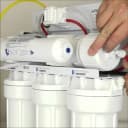
Hailakandi draws much of its water supply from local rivers and lakes in the Barak Valley, a source that carries seasonal challenges. During the monsoon, silt load and organic matter spike sharply, putting strain on filtration stages. Even in drier months, biological contaminants and occasional algae blooms are not uncommon. An Aquaguard purifier sits between your tap and your glass, but it only stays effective if its filters and membrane receive timely attention.
Many households in and around Hailakandi—whether in urban neighbourhoods or semi-rural settings—treat this as a set-and-forget appliance until something visibly fails. A leak appears, flow drops to a trickle, or the taste changes overnight. Understanding what these signs mean, and catching them early through planned maintenance rather than emergency repairs, keeps your purifier working and costs predictable.
Select Service




.webp&w=256&q=75)
Everything you need to know
An Aquaguard RO purifier operates through multiple filtration layers—sediment removal at the first stage, activated carbon for taste and odour, reverse osmosis membrane for dissolved contaminants, and often UV or UF for biological safety. In Hailakandi, the inlet water quality swings significantly across seasons. During the monsoon months, you are asking your purifier to process water with suspended silt, leaf matter, and elevated microbial counts. In the drier season, the load is lighter but more concentrated. Both extremes wear filters differently.
The sediment pre-filter bears the heaviest burden during and shortly after heavy rains. The carbon stage works overtime when water carries taste and odour compounds from standing water or organic decomposition. The membrane itself, if it must process water with a high particulate load because earlier stages are clogged, degrades faster than design specifications predict. Recognising that your water source is not uniform year-round helps you understand why a service interval appropriate for treated municipal water in another city might be too long in Hailakandi.
When your Aquaguard shows trouble, the symptom usually points to which component is failing. Identifying it correctly speeds up repair.
The unit has stopped entirely. Check that the power socket is live and the plug is properly seated. If electricity is reaching the unit but it does not power on, the problem likely involves an internal electrical component such as a solenoid valve or circuit breaker. This requires a technician's diagnosis.
Water is dripping or pooling around the unit. Leaks most often originate from loose fittings at the filter housings, a crack in the storage tank, or a worn seal (O-ring) inside a filter canister. Address this quickly—water damage to flooring, walls or adjacent furniture can be costly. Do not simply place a bucket underneath; call for service the same day you notice it.
Water flow has slowed to a trickle. The pre-filter or sediment cartridge is almost certainly clogged. In Hailakandi, particularly after heavy rainfall, this can happen faster than standard maintenance schedules assume. If replacing the pre-filter does not restore flow, the membrane may be scaling or blocking, requiring replacement or chemical cleaning.
An indicator light is flashing or solid red. This is not a nuisance—it is the system alerting you to a specific need. Do not attempt to override or ignore it. Read your model's manual to confirm what the light indicates, but in nearly all cases it means a filter has reached its end of life or a fault has been detected.
Water is running but tastes or smells off. The activated carbon filter has saturated and is no longer removing chlorine, taste, or odour compounds. Even if the membrane stage is working mechanically, the water's organoleptic quality has declined. This calls for a carbon filter replacement, not a full repair.
When you contact a technician, describe the exact problem you are facing. This helps them prepare. When they arrive, the visit typically unfolds as follows:
The technician begins by listening to your description and examining the unit without opening it. They check the power supply, look for external signs of leakage, and observe any warning lights. They ask questions about when the problem started and how the water has been performing—colour, taste, flow rate. This conversation narrows down which components are most likely at fault before any work begins.
Next, they perform a physical inspection of each stage of the purifier. The sediment cartridge is checked for clogging, the carbon filter for saturation, the membrane for visible damage or scaling, and the storage tank for cracks or loose fittings. The pump, inlet solenoid, and outlet connections all get examined. This thorough look is what separates a quality technician from one who simply replaces the most obvious part.
Once the inspection is complete, the technician explains what they found and provides a cost estimate for any parts and labour needed. Never allow work to proceed without understanding what is being replaced and why. Ask if parts are original Aquaguard components or high-quality compatible alternatives, and confirm which is being used before you approve the repair.
With your go-ahead, replacements happen and any faults are corrected. The purifier is then run through a full cycle to verify that flow, pressure, and output quality have returned to normal. A thorough technician tests the water taste or uses a TDS meter to confirm the membrane is functioning. They record what was done on a service slip and flag when the next filter change is likely needed based on your current usage and water quality.
Service charges vary depending on several factors. Understanding each one helps you budget and compare quotes fairly.
The nature and scope of the problem is the biggest cost driver. Replacing a single sediment filter is a straightforward task with a modest charge. Diagnosing an electrical fault, reseating the solenoid valve, or addressing a pump issue requires more skill and time. If the storage tank has developed a crack or the membrane needs replacement, the parts cost alone will be significantly higher than a routine filter swap.
The specific Aquaguard model you own matters as well. Some models have simpler access to cartridges and filters; others require more disassembly. A technician familiar with your model works faster and more confidently. Filters and membranes designed for different models are not interchangeable, so parts cost is model-specific.
Whether your purifier is within warranty or covered by an active annual maintenance contract dramatically affects what you pay out of pocket. During warranty, many repairs and filter replacements are covered at no additional cost beyond the original purchase. An active AMC typically includes routine maintenance, filter changes, and minor repairs under a single annual fee. Outside warranty and without an AMC, you pay for parts and labour separately.
Urgency can influence pricing as well. A same-day or emergency visit sometimes includes a surcharge over a scheduled appointment. During peak demand periods—the monsoon, when water quality issues spike—technicians may be busier and response times longer, though prices are usually fixed rather than surge-based.
An Annual Maintenance Contract (AMC) consolidates regular upkeep, filter replacements, and minor repairs into one yearly payment. Instead of wondering when the next problem will strike and how much it will cost, you pay a predictable amount and receive scheduled service visits.
An AMC makes strongest sense if your household relies heavily on the purifier—multiple people, daily high usage—because filters deplete faster. If your Aquaguard is not new or no longer under manufacturer warranty, an AMC protects you from unpredictable repair bills. If you value peace of mind and prefer planning expenses rather than encountering surprises, an AMC removes that stress. During Hailakandi's monsoon season, when water quality swings are sharpest and filter clogging accelerates, some households find that an AMC ensuring prompt attention is worth the investment.
An AMC may not be necessary if your purifier is brand-new and still covered under the original manufacturer's warranty, which typically handles defects and replacements at no cost. If your household uses very little water—perhaps just for drinking and cooking—filters last considerably longer and repair incidents are rarer, so paying for an AMC might be over-provisioning. If you are uncertain about staying in your current home or keeping the same purifier long-term, locking into a year-long contract may not suit your situation.
Before enrolling, ask precisely what is included. Some AMCs cover unlimited service visits and all filter replacements within the contract period, while labour on other repairs may be charged separately. Other plans bundle everything but set a limit on filter changes per year. Read the terms carefully so you know exactly what you are paying for and what will cost extra.
When your purifier needs attention, reaching a reliable technician is the priority. Aquaguard customer care channels handle warranty claims, product registration, and formal complaints, but for day-to-day service—filter changes, leak repairs, general maintenance—a local service provider often responds faster. You can reach our Hailakandi service desk on 9311587744. For non-urgent servicing, online booking typically offers the fastest slot selection without waiting on a call queue, and it does not cost more than telephoning.
When you contact a technician, be specific about the issue. Describe what you are observing—low flow, a leak, a warning light—and note when you first noticed it. If you have switched recently to a different water source (relying on a borewell instead of municipal supply, for example) or recently moved house, mention that, as it helps the technician understand the context. Request an estimate of service charges before the work begins so there are no surprises on the bill.
If an issue returns within a week or two of repair, do not assume the technician did shoddy work immediately. Contact the provider and request a follow-up visit. Most service professionals warranty their work for a short period—often 7 to 15 days—and a second visit to address the same complaint is usually provided at no extra charge. Document what has happened: the date of the original visit, what was repaired, and the exact nature of the problem that has returned. This record speeds up resolution.
If the follow-up visit does not solve it, or if you are not confident in the provider, you have the right to seek a second opinion from another technician. Some problems—like a recurring leak—may point to an underlying issue that was not fully addressed the first time. A different technician might diagnose it more accurately. Compare providers based on their willingness to explain problems clearly and their responsiveness, rather than price alone.
The simplest way to avoid expensive repairs is to replace filters and membranes on schedule, before they fail entirely. Waiting until a filter is completely clogged or a membrane stops working forces other components to overcompensate, shortening their lifespan too. A preventive replacement, by contrast, keeps the whole system running at design capacity and reduces strain on the pump and storage tank.
Monitor your purifier regularly without obsessing. Once a month, visually check the unit and the area around it for signs of leakage. Note when indicator lights appear or change. Keep a simple record of filter change dates so you are never guessing how old your current cartridges are. After heavy rainfall or during high-turbidity periods, check the sediment filter more frequently—in Hailakandi, you may need to replace it sooner than the standard schedule suggests.
Position the purifier in a well-ventilated area away from direct sunlight and heat. During a Hailakandi summer, excessive heat stresses the electronics and can warp plastic components. Avoid running the unit when the inlet water pressure is very low, which overworks the pump and can damage its seals. If you have to switch between water sources—municipal supply to borewell or vice versa—inform your technician, as this affects maintenance timing and parts selection.
What makes us different
Hailakandi draws much of its water supply from local rivers and lakes in the Barak Valley, a source that carries seasonal challenges. During the monsoon, silt load and organic matter spike sharply, putting strain on filtration stages. Even in drier months, biological contaminants and occasional algae blooms are not uncommon. An Aquaguard purifier sits between your tap and your glass, but it only stays effective if its filters and membrane receive timely attention.
Many households in and around Hailakandi—whether in urban neighbourhoods or semi-rural settings—treat this as a set-and-forget appliance until something visibly fails. A leak appears, flow drops to a trickle, or the taste changes overnight. Understanding what these signs mean, and catching them early through planned maintenance rather than emergency repairs, keeps your purifier working and costs predictable.
Step-by-step guidance
Don't wait! Get the at the most competitive rates. Contact rocareindia today for a free consultation and quote.
Real repairs · Real customers · Real results

Verified Professionals

Work Assurance

On-Time Support

Covid-19 Safety
Find answers to common questions about our services
Find our nearby franchise stores in your city
Pure water, delivered.