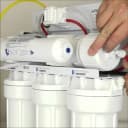
Goalpara draws its water supply from sources fed by the Brahmaputra river system and local groundwater. Unlike cities with centralised, fully treated municipal networks, the water reaching households here carries higher suspended solids, especially during the monsoon months when river flow increases and silt loads spike. This places distinct demands on an Aquaguard purifier's pre-filtration and membrane stages that differ measurably from what the same unit faces in drier regions.
An Aquaguard that runs smoothly in a place with stable, treated supply may show signs of strain within weeks of being installed in Goalpara if its filters are not changed more frequently. Understanding this reality helps you anticipate maintenance needs and avoid surprise breakdowns during the rainy season when service visits take longer to arrange.
Select Service



.webp&w=256&q=75)
Everything you need to know
Sediment filtration is the first barrier in any RO-based purifier. Water enters the pre-filter stage, where solid particles—sand, silt, rust and organic matter from the river—are trapped before reaching the more delicate components. In Goalpara, especially from June through September, the incoming water contains far more sediment than during dry months. This means pre-filters become clogged more rapidly, forcing the pump to work harder to push water through.
A clogged pre-filter does not just slow the output from your Aquaguard. It forces higher pressure through the next stages, which accelerates wear on the carbon filter and RO membrane. By the time you notice that your Aquaguard's flow has dropped to a trickle, the membrane may already be under strain from working above its designed pressure range for weeks. Preventive filter replacement, rather than waiting for performance to drop noticeably, is not optional luxury in a city with Goalpara's water profile—it is basic protection for the purifier's longevity.
Not every sign of trouble means the same thing. Learning to separate a warning that can wait from a breakdown that needs urgent repair saves money and prevents water quality lapses:
Several factors determine what you will pay for a service visit. Understanding them helps you budget and negotiate fairly:
What type of problem you are reporting. A routine filter replacement costs less than diagnosing an electrical fault or replacing a pump. A leak in the storage tank is more involved than tightening a loose fitting.
Which parts need replacement. Sediment filters are the least expensive consumable. Carbon filters and RO membranes cost more. Pumps, solenoid valves and electronic components are at the higher end. Any provider should separate the visit charge from the cost of parts, so you know exactly what each component costs.
Whether your warranty or AMC covers the work. If your Aquaguard is still under manufacturer warranty or you hold an active Annual Maintenance Contract, labour charges and sometimes parts charges are reduced or waived entirely. Always check your documentation before the technician arrives.
Urgency of the visit. A routine appointment scheduled a week in advance costs less than requesting same-day or next-day service. During monsoon season in Goalpara, when demand for water purifier repairs peaks, urgent visits may carry a small premium.
Model complexity. An Aquaguard with UV and UF filtration stages in addition to RO involves more components to inspect and potentially replace than a standard RO model. The technician's labour time, and the range of parts likely needed, both increase.
Before agreeing to any repair, ask the technician to itemise the work and parts in writing. This protects you against inflated charges and gives you a record for warranty or complaint purposes.
An AMC bundles scheduled servicing and filter changes into a single yearly payment. Rather than waiting for your Aquaguard to break down and then scrambling to find a technician and pay an unpredictable bill, an AMC ensures regular attention at a predictable cost.
In Goalpara's context, an AMC becomes more attractive than in cities with gentler water conditions. Because sediment loads are higher and seasonal variations are pronounced, the number of filter changes a purifier needs per year tends to be higher. If your household is using the Aquaguard frequently—which is typical in warm, humid climates where people drink more water—the amortised cost of an AMC often works out lower than paying for individual repairs and filter changes as they arise.
Before purchasing an AMC, confirm exactly what is included. Some plans cover unlimited routine visits and filter changes but exclude replacement of the RO membrane or pump if it fails. Others bundle everything. Reading the fine print prevents disputes if a problem arises after you have signed.
When your purifier stops working or you need routine maintenance, you have a choice between contacting the manufacturer's official support line and reaching out to a local, independent Aquaguard service provider.
Official Aquaguard customer support handles warranty claims, product registration and formal complaints that need to be escalated. For urgent, same-day or next-day repairs—especially during the monsoon when water quality issues compound—a local technician usually responds faster.
You can contact our Goalpara service desk at 9311587744 to book a repair visit, discuss AMC options, or ask questions about which Aquaguard model suits your water conditions. Online booking, where available, lets you describe your issue in writing and select a time slot without depending on phone queues.
When calling or booking, describe what you have observed—slow flow, a red light, water taste—rather than trying to diagnose the problem yourself. The more specific your description, the higher the chance the technician arrives with the right parts and tools to fix it on the first visit.
Knowing how a professional service call unfolds helps you judge whether the work being done is thorough and appropriate:
If a technician begins replacing parts without first explaining the diagnosis, stop the work and ask for a detailed explanation. Unnecessary replacements are one of the most common ways service bills climb higher than they should.
Goalpara's water conditions change markedly across the year. Adjusting your service approach to these cycles keeps your Aquaguard reliable when you need it most:
Monsoon months (June to September). Pre-filters become heavily laden with silt and sediment. If your Aquaguard normally needs a pre-filter change every three months, plan on every six to eight weeks during monsoon. Check your pre-filter canister visually every two weeks—if it appears dark or discoloured, change it even if you are not sure it is clogged. Running a purifier with a heavily saturated pre-filter risks damage to the pump and membrane.
Summer (March to May). Water demand peaks as temperatures rise. The constant flow through your Aquaguard accelerates wear on all filters. Stay alert for reduced output during these months, as it signals filter saturation sooner than it would in cooler seasons.
Winter and post-monsoon (October to February). Water quality stabilizes and sediment loads drop. This is an ideal time to schedule deep servicing or membrane replacement if needed, since demand for technician visits is lower and you are less likely to face water shortage if the unit needs to be taken offline for a few hours.
Occasionally, water quality issues return shortly after a service visit or a repair does not fully resolve the problem. Do not assume you need a different technician or that the issue is unfixable. Follow this approach first:
Request a follow-up visit from the same provider at no additional charge. Most reputable service providers offer a short warranty on their work—typically one to two weeks—during which they will revisit and fix any issues that stem from the original repair. Many recurring problems are quick fixes: a fitting not tightened fully, a filter not seated correctly, or a part installed in the wrong orientation.
If the issue remains unresolved after a second visit, document everything: the date of the original repair, what was replaced, when the problem recurred, and what the follow-up visit found. This paper trail is essential if you decide to file a formal complaint with the manufacturer or seek an alternative service provider.
Before escalating, also confirm that you are using the Aquaguard as intended. If the incoming water pressure is very low, for instance, the unit cannot perform properly regardless of its condition. Some problems attributed to the purifier actually stem from inlet supply issues that are outside the purifier's control.
What makes us different
Goalpara draws its water supply from sources fed by the Brahmaputra river system and local groundwater. Unlike cities with centralised, fully treated municipal networks, the water reaching households here carries higher suspended solids, especially during the monsoon months when river flow increases and silt loads spike. This places distinct demands on an Aquaguard purifier's pre-filtration and membrane stages that differ measurably from what the same unit faces in drier regions.
An Aquaguard that runs smoothly in a place with stable, treated supply may show signs of strain within weeks of being installed in Goalpara if its filters are not changed more frequently. Understanding this reality helps you anticipate maintenance needs and avoid surprise breakdowns during the rainy season when service visits take longer to arrange.
Step-by-step guidance
Don't wait! Get the at the most competitive rates. Contact rocareindia today for a free consultation and quote.
Real repairs · Real customers · Real results

Verified Professionals

Work Assurance

On-Time Support

Covid-19 Safety
Find answers to common questions about our services
Find our nearby franchise stores in your city
Pure water, delivered.