Water quality in and around Umaria presents specific challenges that most other regions don't face. Much of the area draws from borewell systems, where mineral content — particularly calcium and magnesium — runs consistently high. This hardness doesn't just affect taste; it places extra demands on your Eureka Forbes RO purifier's internal components, meaning filters and membranes work harder and wear faster than they would in softer water regions.
Beyond mineral load, seasonal fluctuations in water availability mean that during lean months, remaining water sources become more concentrated, raising total dissolved solids (TDS) levels. Combined, these factors make regular service and maintenance not a luxury but a practical necessity if you want your Eureka Forbes purifier to deliver clean, safe water reliably through the year.
Select Service

.webp&w=256&q=75)
Everything you need to know
Umaria's water characteristics demand a clear understanding of how long various Eureka Forbes filters actually last under local conditions. Unlike generic guidelines found online, a more realistic timeline applies here.
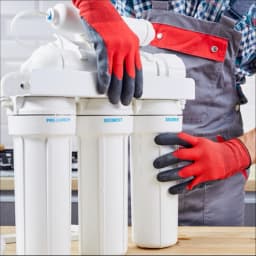
The sediment pre-filter, which catches the first wave of suspended particles and rust that borewells often contain, typically needs replacement every 3 to 4 months in Umaria households rather than the often-quoted 4 to 6 month window. High-hardness water accelerates sediment accumulation inside the pre-filtration stage. When this filter clogs, water pressure inside the system rises, forcing other components to strain and cutting the lifespan of the RO membrane itself.
The carbon filter that removes chlorine, odor, and organic compounds usually gets exhausted every 5 to 6 months. In areas where tap water already carries a mineral-heavy smell or taste, this stage works overtime and wears faster. The RO membrane — the core filtration component that actually removes dissolved salts and contaminants — typically functions between 10 and 16 months in high-hardness areas. Compare this to the 12 to 24 month range you'll see in national marketing materials, and you can see why Umaria residents often experience faster membrane degradation. Finally, the post-carbon filter polishes water just before it reaches your glass and needs annual replacement to maintain taste quality and remove any remaining odor or discoloration.
Setting calendar reminders based on these Umaria-adjusted timelines — rather than relying on the unit's indicator light alone — ensures your Eureka Forbes purifier doesn't fall behind on maintenance and start delivering water that tastes off or carries higher TDS levels than it should.
Most Umaria homeowners don't schedule Eureka Forbes service until the unit has clearly failed. By then, the damage is often more extensive — and more expensive — than catching and fixing issues early would have been. Learning to spot warning signs gives you time to call a technician before you're left without clean drinking water.
A decline in water flow is one of the earliest signals. If the output that once filled a glass in seconds now takes noticeably longer, a clogged pre-filter or sediment stage is the likely cause. In high-hardness regions like Umaria, this happens more frequently than in other areas, so don't dismiss a gradual slowdown as a minor issue. It's your purifier's way of saying a filter change is due soon.
Changes in water taste or appearance matter just as much. Eureka Forbes RO systems produce water that should be clear, colorless, and neutral-tasting. If you notice a sudden metallic tang, saltiness, or faint cloudiness, the membrane may be reaching the end of its effective life and allowing dissolved minerals back through. In high-TDS water areas, this happens faster than you might expect, so trust your senses more than a standard timeline.
Water leakage around fittings, under the sink, or near the storage tank indicates a problem that will only worsen if ignored. Loose connections, cracked housings, and worn-out valves all start with drips and escalate to significant water loss and potential water damage to your kitchen or bathroom. Similarly, if your Eureka Forbes purifier has begun making sounds it didn't make before — continuous humming, grinding noises, or irregular clicking — the pump or internal mechanisms are signaling strain. A technician should inspect this before the component fails entirely.
Finally, most modern Eureka Forbes models include indicator lights that flag when filter life is expiring, TDS levels are rising, or tank status needs attention. If your purifier's light is red or blinking, that's not a warning to ignore. The system has been engineered to alert you at the right moment; waiting another week or two often means the component has already begun affecting water quality.
Umaria residents have essentially two paths when it comes to keeping their Eureka Forbes purifier in working order: paying for individual service visits as needed, or committing to an Annual Maintenance Contract (AMC) that covers scheduled servicing, filter replacements, and minor repairs for a fixed yearly fee.
A single service visit makes sense if your purifier is brand new and still under manufacturer warranty, if you use it very lightly in a small household, or if you suspect a one-time problem rather than systemic wear. A technician will come, diagnose the issue, and provide a quote before any paid work begins. You pay only for what's needed, and there's no long-term commitment.
An AMC plan, by contrast, works better for households that want predictable costs and guaranteed regular maintenance. Instead of hoping you remember when filters are due or scrambling to find a technician when something breaks unexpectedly, the service provider schedules visits proactively. In a region like Umaria where borewell water demands more frequent filter changes than the national average, this planned approach often costs less over a full year than booking technicians individually whenever you notice a problem. AMC plans also typically include priority scheduling during peak demand periods — such as when pre-monsoon water quality dips or post-monsoon turbidity spikes — ensuring you don't end up on a waiting list when every Eureka Forbes user in town is calling for help simultaneously.
Before deciding which route suits your household, calculate your actual usage patterns and water quality challenges. A family of five on borewell water in Umaria will likely benefit more from an AMC plan than a retired couple using municipal supply, even though both live in the same area. Transparency from the service provider about what each option includes — visit charges versus part costs, coverage limits, and any exclusions — helps you make an informed comparison rather than discovering hidden costs later.
When someone decides to call a Eureka Forbes technician, understanding the cost structure prevents sticker shock and helps you budget appropriately.
Service charges typically split into three components: the technician's visit fee, labor costs for any work performed, and parts themselves. The visit fee is straightforward — it's what you pay simply to have someone come to your home and assess the purifier. This is non-refundable even if the technician determines nothing needs to be done immediately. Labor cost covers the time spent performing actual repairs or replacements. Parts cost is what you pay for filters, membranes, gaskets, valves, or other internal components that need replacing.
The total bill varies based on several local and household-specific factors. High-hardness water in Umaria means filter replacements happen more frequently than in softer-water regions, so annual parts costs tend to be higher here than in, say, areas on treated municipal supply. The specific Eureka Forbes model you own also matters — a basic RO-only unit costs less to service than a hybrid RO-UV-UF model with more internal stages. How long it's been since your last service affects the extent of cleaning and inspection required; a purifier that hasn't been serviced in two years will require deeper sanitization than one that's been maintained regularly, raising labor costs.
Location within and around Umaria can introduce minor variations in service charges, since local labor rates and travel distances differ across neighborhoods. A technician visiting a compact town location may schedule more appointments per day than one serving scattered rural parcels, and this affects their per-visit pricing structure.
Before any work begins, always ask for a written estimate that breaks these three components down separately. A transparent service provider will inspect your purifier, identify what needs attention, and quote the total cost with justification before proceeding. This practice protects you from surprise bills and gives you the chance to approve or decline work based on the stated cost.
Knowing the sequence of a typical service visit helps you recognize whether a technician is performing thorough work or cutting corners.
A service visit that skips tank cleaning, uses generic parts instead of Eureka Forbes-specific filters, or omits the final testing phase is not performing at a standard you should accept. These steps exist because they directly impact how long your purifier lasts and how safe the water remains.
Regular service is essential, but what happens between technician visits also affects how well your Eureka Forbes purifier performs and how much you ultimately spend on maintaining it.
Never allow the purifier to run when the inlet water supply is not connected or the supply line is empty. Doing so creates an internal vacuum that strains the pump. In areas like Umaria where water supply can be intermittent during dry seasons, remember to turn off the purifier if tap water is not flowing; this simple habit prevents unnecessary pump wear during lean-water periods.
Keep the exterior unit and water taps free of dust and debris. Dust accumulation around air vents, connectors, and the base can restrict airflow and cause internal components to overheat. A quick wipe-down with a dry cloth every month takes seconds and protects the circuitry and pump from heat-related damage.
Respect the indicator light system built into your Eureka Forbes model. These lights exist specifically to flag maintenance needs before they become severe. If the light turns red or blinks, take it as an immediate signal to call a technician rather than waiting to see if the problem resolves itself.
Maintain good ventilation around the purifier. The pump and internal mechanisms generate heat during operation; if the unit is crammed into a closed cabinet with poor air circulation, components can degrade faster than normal, especially during hot months common in Madhya Pradesh.
Write down the date of your last service in a visible spot — a sticker on the purifier itself or a note near your kitchen calendar. Keeping this information accessible helps you stay on schedule rather than losing track and accidentally going months beyond your recommended service interval.
There are times when a routine technician visit isn't what you need. Warranty-related questions, product registration issues, and recalls should go through official Eureka Forbes customer care channels rather than an independent technician. The Eureka Forbes customer care number is the quickest route for these inquiries, since they have access to your product's warranty status, original purchase records, and any recalls or service bulletins affecting your specific model.
During peak seasons — particularly the pre-monsoon period when water demand spikes in Umaria — official customer care lines do experience longer wait times. Keep this in mind if you're calling to check warranty coverage or registration status. For non-warranty work such as routine filter changes or minor repairs outside of warranty scope, an experienced independent Eureka Forbes technician can often respond faster and may offer more flexible scheduling than the official care channel.
Distinguishing between warranty work and routine maintenance before you call saves time and ensures you're directed to the right support stream immediately.
What makes us different
Water quality in and around Umaria presents specific challenges that most other regions don't face. Much of the area draws from borewell systems, where mineral content — particularly calcium and magnesium — runs consistently high. This hardness doesn't just affect taste; it places extra demands on your Eureka Forbes RO purifier's internal components, meaning filters and membranes work harder and wear faster than they would in softer water regions.
Beyond mineral load, seasonal fluctuations in water availability mean that during lean months, remaining water sources become more concentrated, raising total dissolved solids (TDS) levels. Combined, these factors make regular service and maintenance not a luxury but a practical necessity if you want your Eureka Forbes purifier to deliver clean, safe water reliably through the year.
Step-by-step guidance
Don't wait! Get the at the most competitive rates. Contact rocareindia today for a free consultation and quote.
Real repairs · Real customers · Real results

Verified Professionals

Work Assurance

On-Time Support

Covid-19 Safety
Find answers to common questions about our services
Find our nearby franchise stores in your city
Pure water, delivered.