Borewell Water and Membrane Life: What You Need to Know
The water reaching Banaskantha households through borewells carries dissolved minerals at concentrations that vary significantly by location and season. During dry months, TDS levels can climb even higher, which means your Eureka Forbes membrane is filtering far more mineral content in summer than it does after monsoon recharge. This seasonal variation makes a fixed service schedule less reliable than it is in areas with stable municipal supply.
A membrane that would comfortably last 18 months on standard municipal water may need replacement in 10 to 12 months when handling borewell supply consistently. The pre-filters and sediment stages clog faster too, since bore water often carries more visible particles alongside the dissolved salts. Skipping even one scheduled filter change in this environment can cause your membrane to work under stress, shortening its overall lifespan significantly and potentially allowing harder water to reach your tap than you realize.
Recognizing When Your Purifier is Struggling
In Banaskantha's environment, pay close attention to these specific warning signs that indicate your Eureka Forbes unit needs immediate attention:
- TDS readings climbing toward the unfiltered level. If your output water TDS is no longer dropping significantly from inlet TDS, the membrane is likely failing or severely fouled. Most Eureka Forbes models have a TDS display — check it weekly rather than waiting for a crisis.
- Whitish residue or scale deposits forming around the tap or inside the glass. This mineral scaling visible on the hardware itself signals that mineral content in the output water has risen above normal, suggesting filter degradation.
- Slower flow that worsens weekly. Progressive reduction in water pressure, especially during dry season months, indicates sediment filter clogging. In high-TDS areas, this acceleration is faster than in other regions.
- Storage tank contamination or sediment visible inside. If you notice brownish tint or particles in the storage tank's water, a technician should inspect the entire filtration chain urgently, as this can indicate leakage or backflushing issues.
- Unusual taste returning after months of good service. Since your borewell water starts with higher mineral content, any taste change often signals carbon filter exhaustion or early membrane fouling — not a temporary water quality fluctuation.
Acting quickly when you notice these signs prevents a situation where Eureka Forbes repair needs become more extensive and costly.
Understanding Service Costs in Banaskantha's Context
The expense of an Eureka Forbes water purifier service visit in Banaskantha depends on several factors specific to this region and your specific situation:
- Mineral content in your borewell water. Higher TDS water requiring more frequent membrane replacement creates higher ongoing service costs than households on cleaner water sources. This is not a hidden charge — it's a real consequence of your water supply.
- Time since the last service. A purifier maintained on schedule with simple filter changes costs far less per visit than one neglected for months, which may require deeper tank cleaning or multiple component replacements.
- Distance from service center. Rural or semi-urban areas within Banaskantha may see slightly higher travel-related charges than Palanpur town itself, though this varies by individual technician availability.
- Spare parts availability locally. Genuine Eureka Forbes filters and membranes for high-TDS environments may need to be sourced specially, which can affect delivery and total cost.
- Model age and design complexity. Older Eureka Forbes purifiers sometimes require parts that are discontinued or harder to source, whereas newer models with standardized components are quicker and less expensive to repair.
A transparent service provider will explain how your water's specific characteristics (TDS, hardness) influence the type and cost of maintenance your unit needs, rather than offering a one-size-fits-all estimate.
Does an AMC Plan Make Sense for Banaskantha Households?
An Annual Maintenance Contract typically covers scheduled visits, filter replacements, and minor repairs within a fixed yearly fee. For homes drawing on borewell water with high TDS, an AMC plan often delivers better value than pay-per-visit servicing.
Here's why: if your water requires membrane replacement every 10 to 12 months instead of the standard 18 months, and pre-filters need changing every 3 to 4 months rather than 6 months, the cumulative cost of individual service calls can exceed what a structured AMC would charge. An AMC plan typically accounts for this higher-frequency maintenance and builds it into the annual fee, removing the surprise of unexpected expenses.
However, an AMC plan only saves money if it covers what you actually need. Before committing, confirm that the plan includes:
- Quarterly or biannual visits appropriate to your water quality
- Membrane replacement without additional surcharge if your water quality demands it
- Tank cleaning and sanitization at scheduled intervals
- Access to priority booking during peak seasons when borewell water stress is highest
- Clear terms on whether major component replacements (pump, housing) are covered or only filter-level maintenance
An AMC plan that promises the same maintenance schedule as other regions, without acknowledging Banaskantha's water challenges, is unlikely to be right for you.
Filter Replacement Schedules for High-TDS Water
Standard filter replacement timelines published by manufacturers assume moderate water hardness and TDS. Banaskantha borewell conditions require more aggressive replacement schedules to keep your Eureka Forbes purifier delivering genuinely safe water.
Use these adjusted timelines as a starting point, then observe your actual TDS output and water quality to refine:
- Sediment pre-filter: Replace every 3 to 4 months in high-TDS borewell areas. If you notice visible sediment, clouding, or significantly reduced flow, replace immediately rather than waiting.
- Carbon filter: Change every 4 to 5 months. In areas with higher dissolved mineral content, carbon also absorbs taste compounds associated with mineral-heavy water, so it saturates faster.
- RO membrane: Plan for replacement every 10 to 14 months rather than the standard 12 to 24 months. Check output TDS monthly; a persistent rise signals membrane fouling and warrants earlier replacement.
- Post-carbon polishing filter: Replace every 6 to 8 months. This final stage matters more when your source water is challenging.
Tracking your actual water quality changes between service visits helps your technician fine-tune the schedule for your specific borewell and household consumption pattern.
Booking Eureka Forbes Service in Banaskantha
Getting a technician to your home involves several steps, and knowing what to expect beforehand saves time:
- Contact your service provider with specific information. Mention your model number, describe any symptoms (slow flow, taste change, TDS reading if you have one), and note whether you're in Palanpur town or a more rural area.
- Ask for an estimated visit date and travel time. In districts like Banaskantha with scattered settlements, a technician serving multiple locations may need a few days to reach remote areas. Booking a group visit — combining your service with neighbors' appointments — sometimes reduces wait time.
- Request a cost estimate upfront. Based on your water type and purifier model, a reliable provider should indicate whether this visit will involve filter replacement, membrane change, tank cleaning, or a combination. This estimate helps you budget and avoid surprise bills.
- Prepare access to electricity and water. During service, the technician needs to run the purifier, test output, and clean components. Clearing the space around the unit beforehand speeds up the work.
- Document the condition of your unit before the technician arrives. Note any visible leaks, sounds, or TDS readings. This gives the technician useful context and protects you if there are questions later about what was working or broken.
What a Complete Eureka Forbes Service Visit Includes
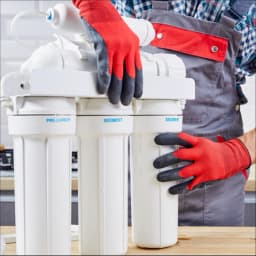
A thorough Eureka Forbes service doesn't just swap out filters — it addresses the entire purification chain. Here's what happens during a professional visit:
- System diagnosis. Technician measures inlet water TDS and hardness, compares it to outlet TDS, checks flow rate, and inspects for leaks or visible damage.
- Individual filter assessment. Each stage — sediment, carbon, RO membrane, post-filter — is examined separately. This prevents unnecessary replacement of components that still have useful life remaining.
- Tank inspection and cleaning. The storage tank is inspected for sediment, bacterial growth, or scale deposits. In high-TDS areas where mineral accumulation is common, thorough tank cleaning is especially important.
- Component sanitization. Valves, fittings, and the tap itself are cleaned to remove mineral buildup or biofilm that can affect water taste even after filters are fresh.
- Replacement work. Only parts that actually need replacing are changed, with your approval. The technician should explain what's being replaced and why.
- Final water quality testing. After service, the purifier is run and water samples tested to confirm TDS reduction and flow rate meet expected levels before the technician leaves.
- Service documentation. You receive a written record of what was done, which parts were replaced, and when the next service is recommended based on your specific water conditions.
Avoiding Common Service Mistakes
Several pitfalls make Eureka Forbes service more expensive or less effective than it needs to be. Watch out for these:
- Replacing all filters simultaneously without checking which ones actually need changing. This inflates the bill unnecessarily. A good technician replaces only what's truly worn.
- Ignoring the storage tank during service. In Banaskantha's mineral-heavy water environment, tank cleaning is not optional — it's as important as filter replacement to prevent contamination.
- Using non-genuine replacement parts to save cost. Low-grade filters wear out faster and can compromise water quality more severely than the original problem they were meant to fix.
- Scheduling service only when there's an obvious failure rather than proactively. By the time symptoms appear, internal damage has often already begun. Preventive maintenance is significantly cheaper.
- Assuming your purifier needs the same maintenance schedule as someone else's. Your specific water TDS and hardness make your maintenance needs unique — a one-size-fits-all plan often misses the mark.
Eureka Forbes Support and Warranty Questions
When purchasing or servicing an Eureka Forbes purifier, warranty and customer support matter significantly. Most new units come with a manufacturer warranty covering defects in materials and workmanship, but the warranty does not typically include filter replacements or damage from extended neglect.
If your purifier is still under warranty, contacting Eureka Forbes customer care before booking a paid repair visit can clarify whether specific work is covered at no charge. However, for routine maintenance — filter changes, scheduled cleaning, and non-warranty repairs — independent trained technicians specialized in Eureka Forbes systems often provide faster response than official channels during peak demand periods.
Keeping your original purchase invoice, warranty card, and serial number easily accessible means you can verify coverage status quickly rather than spending time on the phone troubleshooting.