
Best Commercial RO Systems for Indian Small Businesses
Water Quality Solutions for Small Businesses: Complete Guide to Commercial Purification Systems
Water quality remains a critical concern for enterprises across India, particularly those operating in sectors where clean drinking water is essential for both employees and customers. Small and medium-sized establishments, from restaurants and cafes to corporate offices and retail outlets, require reliable water treatment solutions that can handle daily demands without compromising on quality. The landscape of water purification technology has evolved significantly, offering business owners multiple options that cater to different needs, budgets, and operational requirements.
For entrepreneurs and business managers, selecting an appropriate water treatment system involves understanding various factors including daily water consumption, source water quality, available space, and maintenance requirements. Unlike residential purifiers, business-grade equipment must withstand higher usage volumes while maintaining consistent output quality throughout operating hours. The investment in quality water treatment infrastructure not only ensures compliance with health standards but also reflects positively on business reputation and employee welfare.
Indian businesses face unique challenges when it comes to water quality, with regional variations in TDS levels, contamination types, and municipal water supply reliability. Metropolitan areas often receive treated municipal water with moderate TDS levels, while industrial zones and semi-urban locations may contend with higher contamination levels requiring more robust filtration approaches. Understanding these local conditions becomes the foundation for making informed decisions about water purification investments.
The commercial purifier market in India has matured considerably, offering businesses access to advanced technologies that were once available only to large industrial facilities. Modern systems incorporate multiple purification stages, smart monitoring features, and efficient waste water management, making them suitable for establishments with limited technical expertise. This democratization of technology means even small businesses can now access enterprise-grade water quality without requiring dedicated maintenance staff.
Understanding Reverse Osmosis Technology for Business Applications
Reverse osmosis represents the gold standard in water purification, employing a semi-permeable membrane that removes dissolved solids, heavy metals, bacteria, viruses, and other contaminants at the molecular level. The process works by applying pressure to push water through microscopic pores in the membrane, leaving contaminants behind while allowing pure water molecules to pass through. This technology proves particularly effective in Indian conditions where groundwater and municipal supplies often contain elevated levels of dissolved impurments.
Business applications require systems designed for continuous operation with higher flow rates compared to household units. Industrial water filter configurations typically include pre-filtration stages using sediment filters and activated carbon to protect the delicate RO membrane from premature degradation. These preliminary stages remove larger particles, chlorine, and organic compounds that could otherwise reduce membrane lifespan and efficiency.
The capacity of business-oriented systems ranges from 25 liters per hour for small offices to several hundred liters per hour for restaurants, hospitals, and manufacturing facilities. Calculating the appropriate capacity requires assessing peak hour demand rather than average consumption, ensuring the system can handle busy periods without compromising water availability. A general guideline suggests providing 15-20 liters per person per day for office environments, with higher requirements for food service establishments.
Storage capacity constitutes another crucial consideration, as purification rates may not always match instantaneous demand. Most commercial setups incorporate storage tanks ranging from 50 to 500 liters, providing a buffer that ensures continuous availability even during peak usage times. Stainless steel tanks offer durability and hygiene advantages over plastic alternatives, though they come at a higher initial cost.
Key Features That Define Business-Grade Water Treatment Systems
High recovery rates distinguish quality business systems from basic models, determining how efficiently source water converts to purified output. While household purifiers might have recovery rates of 30-40 percent, advanced commercial units achieve 50-60 percent efficiency, significantly reducing water wastage and operational costs. This efficiency becomes particularly important in regions facing water scarcity or where water supply costs form a substantial operational expense.
Multi-stage purification protocols ensure comprehensive contaminant removal across different categories. A typical configuration includes sediment filtration for suspended particles, activated carbon for chlorine and organic compounds, RO membrane for dissolved solids and microorganisms, and post-filtration stages that may include UV sterilization and mineral cartridges for taste enhancement. This layered approach addresses the diverse contamination profile found in Indian water sources.
Monitoring and diagnostic capabilities have become standard in modern business systems, with digital displays showing water quality parameters, filter life indicators, and performance metrics. Some advanced models offer remote monitoring through mobile applications, allowing business owners to track system performance, receive maintenance alerts, and diagnose issues without requiring on-site inspection. These features minimize downtime and help schedule preventive maintenance efficiently.
Energy efficiency directly impacts operational costs, making it an important selection criterion. Systems with energy-saving pumps and optimized operating pressures reduce electricity consumption while maintaining purification effectiveness. For businesses operating extended hours, these efficiency gains translate to substantial savings over the equipment lifespan.
Categories of Water Treatment Systems for Business Environments
Under-counter installations suit establishments with limited visible space, hiding the purification system while providing convenient access through dedicated taps. These compact configurations work well for small offices, boutique hotels, and retail spaces where aesthetics matter. Despite their compact footprint, modern under-counter units can deliver substantial daily capacities suitable for teams of 20-30 people.
Floor-standing models offer higher capacities and easier maintenance access, making them popular for restaurants, hospitals, and larger office complexes. These freestanding units typically include integrated storage tanks and can be positioned in utility areas or kitchens without requiring cabinet modifications. Their modular design facilitates servicing and component replacement without disrupting operations significantly.
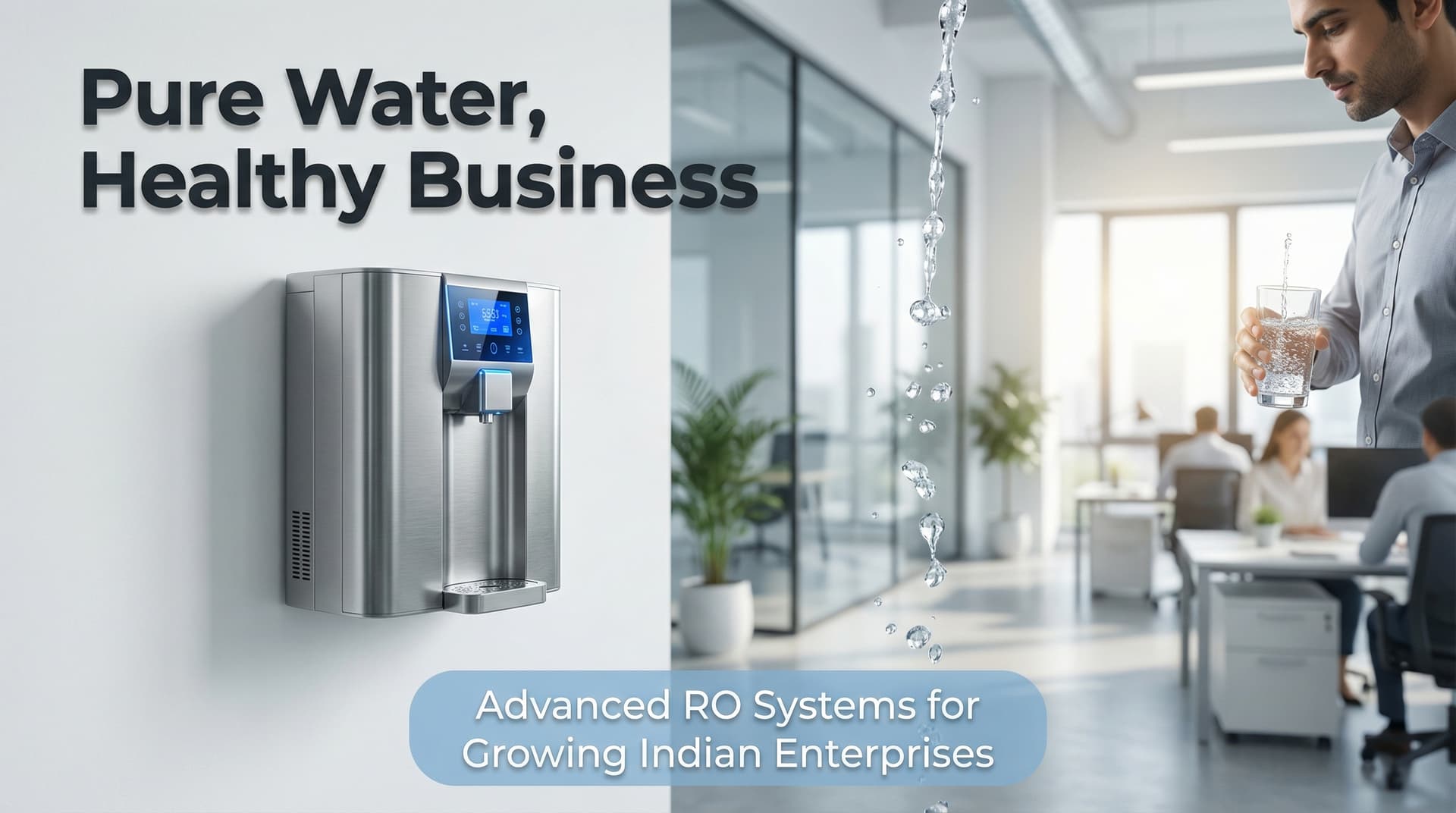
Wall-mounted systems maximize floor space utilization while providing adequate capacity for medium-sized establishments. These installations require proper wall support but offer the advantage of keeping purification equipment away from floor-level contamination and cleaning activities. Many modern wall-mounted designs incorporate sleek aesthetics that complement contemporary office interiors.
Centralized purification plants serve multi-floor buildings or campuses, distributing purified water through dedicated piping to multiple consumption points. While requiring higher initial investment and professional installation, these systems offer economies of scale for larger establishments and eliminate the need for multiple point-of-use purifiers. Centralized approaches also simplify maintenance management and quality control. For larger facilities consider a Ro Plant.
Established Brands Serving the Business Water Treatment Segment
The Indian market features several reputable manufacturers with proven track records in commercial water purification. Doctor Fresh has built recognition for systems designed specifically for healthcare and food service applications, emphasizing hygiene and reliability. RO Care India offers comprehensive solutions with strong after-sales support networks across metropolitan and tier-two cities, making them accessible to businesses in various locations.
Mannubhai Service Expert specializes in customized installations for industrial and commercial clients, providing tailored solutions based on specific water quality challenges and consumption patterns. Their technical expertise helps businesses navigate complex water treatment requirements beyond standard offerings.
Kent has expanded from residential to commercial markets, leveraging their RO plus UV plus UF technology combination in business-grade configurations. Aquaguard offers a range of commercial models with different capacity options suitable for varied business scales. Aquafresh focuses on value-oriented solutions for cost-conscious businesses without compromising essential purification standards.
Blue Star brings their air conditioning and water cooling expertise to commercial water purification, offering integrated solutions for hospitality and corporate sectors. LG has entered the commercial space with systems featuring smart connectivity and contemporary designs appealing to modern workplaces. Pureit provides business solutions backed by extensive research in water quality challenges specific to Indian conditions.
Maintenance Considerations and Operational Planning
Regular filter replacement forms the cornerstone of maintaining purification effectiveness and system longevity. Sediment and carbon filters typically require replacement every 6-12 months depending on source water quality and usage volume. The RO membrane, being the most expensive component, generally lasts 2-3 years with proper pre-filtration and regular cleaning. Establishing relationships with reliable Ro Service ensures timely maintenance and minimizes system downtime.
Water quality testing should be conducted periodically to verify system performance and identify any degradation in output quality. Simple TDS meters provide quick assessments, while comprehensive laboratory testing reveals the presence of specific contaminants. Maintaining test records demonstrates due diligence in providing safe drinking water to employees and customers.
Sanitization protocols prevent bacterial growth in storage tanks and distribution lines, particularly important in commercial settings where water may sit for extended periods. Annual sanitization using food-grade disinfectants ensures the entire system remains hygienic beyond just the purification stages. This practice proves especially critical for food service businesses where water quality directly impacts product safety.
Spare parts availability influences the total cost of ownership and operational reliability. Selecting systems from manufacturers with established distribution networks ensures quick access to replacement components. Generic or refurbished parts may offer cost savings but can compromise performance and void warranties, making genuine components a worthwhile investment.
Cost Analysis and Financial Planning
Initial investment varies significantly based on capacity, features, and brand positioning, ranging from 25,000 to 200,000 rupees for most small business applications. While budget considerations naturally influence selection, focusing solely on upfront costs often leads to higher total ownership expenses through increased maintenance needs, shorter equipment life, and higher water wastage.
Operating costs include electricity consumption, water supply expenses, and routine consumable replacement. Energy-efficient models may cost more initially but deliver savings over their operational life. Similarly, systems with better recovery rates reduce water bills in areas where municipal water is metered or where businesses rely on tanker supplies.
Maintenance contracts offered by manufacturers or third-party service providers typically range from 3,000 to 15,000 rupees annually, depending on system complexity and service frequency. These agreements provide predictable budgeting and priority response times, valuable for businesses where water supply interruption affects operations. Evaluating contract terms carefully ensures adequate coverage without paying for unnecessary services.
Return on investment extends beyond direct costs to include intangible benefits like improved employee health, enhanced customer perception, and elimination of bottled water expenses. Many businesses find that quality water purification systems pay for themselves within 18-24 months through bottled water savings alone, while delivering additional operational and reputational advantages.
Installation Requirements and Space Planning
Pre-installation water testing reveals the specific treatment challenges present in the source water, informing system selection and configuration. Testing parameters should include TDS, hardness, iron content, microbial contamination, and pH levels. This data helps match system capabilities to actual treatment needs rather than relying on generic solutions that may prove inadequate or unnecessarily complex.
Electrical and plumbing infrastructure must support the selected system, with adequate power supply, proper grounding, and appropriate water pressure. Most commercial systems require standard single-phase power but may need dedicated circuits to prevent interference with other equipment. Water supply pressure should fall within the system's specified range, with booster pumps added where municipal pressure proves insufficient.
Drainage facilities for reject water disposal require planning, particularly for systems with lower recovery rates that generate substantial wastewater. Some businesses collect reject water for secondary uses like floor cleaning, landscaping, or toilet flushing, improving overall water efficiency. Local regulations regarding wastewater disposal should be verified to ensure compliance.
Accessibility for maintenance activities influences installation location selection, as technicians need adequate space to service components and replace filters. Positioning systems in well-ventilated areas away from direct sunlight and extreme temperatures extends equipment life and maintains optimal performance.
Emerging Trends in Business Water Purification
Smart monitoring technologies increasingly integrate with commercial water treatment systems, providing real-time data on water quality, consumption patterns, and maintenance requirements. Cloud-based platforms allow multi-location businesses to monitor all installations centrally, identifying performance issues before they cause service interruptions. Predictive maintenance algorithms analyze usage patterns and component performance to schedule servicing optimally.
Sustainability focus drives innovation in water recovery and energy efficiency, with new membrane technologies achieving higher purification rates while using less energy and generating less waste. Zero liquid discharge systems represent the cutting edge for environmentally conscious businesses, recycling reject water through additional treatment stages until virtually all input water becomes usable.
Modular and scalable designs accommodate business growth without requiring complete system replacement. Adding capacity modules or upgrading specific components allows businesses to match their water treatment infrastructure to evolving needs. This flexibility proves particularly valuable for growing enterprises uncertain about future space or consumption requirements.
Touchless dispensing options gained prominence following health concerns around shared contact surfaces, with sensor-activated taps and dispensers becoming standard in many commercial installations. These features enhance hygiene while providing convenience in high-traffic environments.
Regulatory Compliance and Quality Standards
Bureau of Indian Standards specifications provide benchmarks for drinking water quality, setting maximum acceptable limits for various contaminants. Business owners bear responsibility for ensuring their water treatment systems consistently meet these standards, with documentation available for inspection by health authorities. IS 10500 defines acceptable water quality parameters applicable to commercial establishments.
Food Safety and Standards Authority of India regulations apply to businesses in food service, hospitality, and food processing sectors, imposing specific requirements for water used in food preparation and customer consumption. Non-compliance can result in penalties, operational restrictions, or license revocation, making proper water treatment a regulatory necessity beyond just a quality consideration.
Occupational health guidelines recommend that employers provide adequate safe drinking water for employees, with specifications regarding accessibility and quality. Implementing robust water purification systems helps businesses meet these obligations while demonstrating commitment to worker welfare.
Third-party certifications from organizations like NSF International or Water Quality Association provide independent verification of system performance and safety. While not mandatory in India, these certifications offer additional assurance of quality and can strengthen business credibility with health-conscious customers.
Making the Final Selection Decision
Capacity matching involves calculating peak demand rather than average consumption, ensuring adequate water availability during busy periods without excessive oversizing that increases costs and space requirements. Working with experienced vendors to conduct proper assessments prevents common mistakes of under or over-specification.
Technology matching to water quality challenges ensures the selected system effectively addresses specific contamination issues present in the source water. Areas with high TDS require robust RO systems, while those with primarily microbial contamination might use UV-focused solutions. Comprehensive source water testing informs these technology decisions.
Service network evaluation protects long-term operational reliability, as even the best equipment requires periodic maintenance and occasional repairs. Manufacturers or vendors with local service presence provide faster response times and better support compared to those requiring technicians to travel from distant cities.
Total cost of ownership analysis spanning five years provides a realistic picture of financial commitment, including initial purchase, installation, consumables, energy, water, and maintenance costs. This comprehensive view often reveals that mid-range systems offer better value than either budget or premium options for typical small business applications.
Conclusion
Selecting appropriate water purification infrastructure represents a significant business decision that impacts operations, costs, and stakeholder satisfaction for years. The diverse range of commercial purifiers available in the Indian market provides options suitable for virtually every business type and size, from small offices to busy restaurants. Understanding the technical aspects of reverse osmosis technology, capacity requirements, and maintenance considerations empowers business owners to make informed choices aligned with their specific needs.
The evolution of business-grade water treatment systems has made advanced purification technology accessible and affordable for small businesses, eliminating the historical advantage large corporations held in providing quality drinking water. Modern systems combine effectiveness, efficiency, and ease of use in configurations that integrate seamlessly into business operations without requiring specialized technical expertise. Investment in quality water treatment delivers returns through bottled water savings, improved health outcomes, enhanced business reputation, and regulatory compliance.
Success in implementing commercial water purification depends on thorough needs assessment, realistic capacity planning, selection of reputable equipment, and commitment to regular maintenance. Businesses that approach water treatment strategically, viewing it as essential infrastructure rather than optional expense, consistently achieve better outcomes in terms of reliability, cost management, and stakeholder satisfaction. The availability of established brands with proven commercial solutions further reduces implementation risks and provides confidence in long-term performance.
As water quality challenges intensify across India and awareness of health implications grows, businesses that proactively address water purification position themselves advantageously. Quality water treatment becomes a competitive differentiator, particularly in customer-facing industries where perceptions of hygiene and care significantly influence business success. For small business owners navigating the selection process, focusing on proven technologies, adequate capacity, reliable service support, and total ownership costs provides the framework for decisions that serve their enterprises well into the future.
Protecting your business with reliable water purification requires understanding your specific needs and local water conditions. Explore comprehensive guides on water quality testing, system maintenance schedules, capacity planning tools, or Buy water purifier to help you make informed decisions that safeguard both employee wellness and operational efficiency for years to come.
Frequently Asked Questions
Q - What capacity should I choose for my small business water purification system?
A - Calculate your peak hour demand rather than average daily consumption. For office environments, estimate 15-20 liters per person per day, while restaurants and cafes require higher capacities. Small offices with 20-30 employees typically need systems producing 25-50 liters per hour, whereas busy food service establishments may require 100-200 liters per hour. Always factor in a buffer for growth and unexpected demand spikes to avoid running short during critical business hours.
Q - How often do commercial water purifiers require maintenance and what does it involve?
A - Regular maintenance includes replacing sediment and carbon filters every 6-12 months, depending on source water quality and usage volume. The membrane typically lasts 2-3 years with proper care. Annual sanitization of storage tanks prevents bacterial growth. Most businesses benefit from annual maintenance contracts that include scheduled filter replacements, performance testing, and system sanitization, ensuring consistent water quality and minimizing unexpected breakdowns.
Q - Can commercial systems help reduce operational costs compared to bottled water?
A - Yes, businesses typically recover their investment within 18-24 months through bottled water savings alone. A small office consuming 50 liters daily spends approximately 30,000-40,000 rupees annually on bottled water, while operating a commercial purifier costs around 15,000-20,000 rupees yearly including electricity, maintenance, and consumables. The savings multiply significantly for larger establishments with higher consumption, making purification systems financially advantageous beyond health and convenience benefits.
Q - What factors determine which purification technology is best for my business location?
A - Source water quality drives technology selection. Areas with high dissolved solids require robust membrane-based systems, while locations with primarily microbial contamination may use ultraviolet-focused solutions. Conduct comprehensive water testing measuring hardness, dissolved solids, iron content, microbial presence, and pH levels before selecting equipment. Regional variations across India mean metropolitan areas face different challenges than industrial zones or semi-urban locations, making customized solutions more effective than generic approaches.
Short Informational CTA
Protecting your business with reliable water purification requires understanding your specific needs and local water conditions. Explore comprehensive guides on water quality testing, system maintenance schedules, and capacity planning tools to help you make informed decisions that safeguard both employee wellness and operational efficiency for years to come.