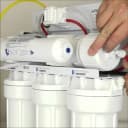
How Jhajjar's Water Characteristics Affect Your RO System
The groundwater that reaches most residential areas in Jhajjar carries dissolved minerals — primarily calcium and magnesium salts — that give it a distinctly hard character. Municipal and private borewell supplies often register TDS levels between 600 and 1000 mg/l, well above the WHO-recommended threshold of 500 mg/l for drinking water. This mineral load has a direct impact on how quickly your purifier's filters clog and how often the RO membrane loses effectiveness.
When you draw water from a borewell or municipal line in Jhajjar, the pre-filtration stages of your Eureka Forbes unit face continuous exposure to sediment, dissolved salts, and mineral particles. The sediment filter becomes saturated faster, carbon layers lose their absorptive capacity ahead of schedule, and the RO membrane itself can suffer mineral scaling — a process where calcium deposits build up on the membrane surface, reducing its ability to reject dissolved solids. Seasonal variations matter too. During summer months when water demand peaks, the strain on your system increases, while winter scaling issues intensify as colder water temperature affects mineral solubility and sediment settling.
Recognizing When Your Purifier Needs Professional Attention
Paying attention to these specific symptoms helps you catch problems before they worsen:
- Noticeably reduced water output. In Jhajjar's mineral-rich water conditions, a clogged sediment or carbon filter restricts flow far more dramatically than in areas with softer water. When your purifier suddenly fills a glass slower than usual, a filter change is likely overdue.
- Water develops a faint mineral or salty taste. This signals that the RO membrane is no longer rejecting dissolved salts as effectively, often due to mineral scaling or membrane degradation from extended use in hard water.
- Scale deposits visible around the unit or drain line. Jhajjar's high TDS water sometimes leaves white crystalline buildup on fittings and connections. This is a sign that mineral accumulation is occurring inside the system as well.
- Unusual vibration or grinding noise from the pump. Hard water puts additional mechanical stress on the pump motor. If the unit sounds different from its normal operation — rougher, more strained — internal wear may be progressing.
- The storage tank develops a stale or musty odor. When filters aren't replaced on schedule, organic and mineral residues accumulate in the tank, creating conditions for bacterial growth and unpleasant smells.
- Indicator lights or digital display show a fault code. Modern Eureka Forbes models often flash alerts for low TDS rejection, high water temperature, or membrane pressure warnings. Acting on these alerts prevents sudden shutdowns.
The Service Process and What Technicians Check
When a qualified technician arrives to service your Eureka Forbes purifier in Jhajjar, the visit follows a structured approach:
- Water quality testing. The technician measures incoming water TDS, pH, and flow rate, then compares these with the purifier's output. In Jhajjar, this baseline tells you whether mineral content is affecting filtration performance.
- Individual filter assessment. Each stage — sediment, carbon, and RO membrane — gets examined separately. Filters aren't automatically replaced; the technician inspects them for saturation, discoloration, or structural damage before recommending replacement.
- Membrane pressure check. The technician measures membrane pressure under normal operating conditions. High pressure readings often indicate scaling, which is common in hard water areas and requires either deep cleaning or membrane replacement.
- Internal cleaning and sanitization. The storage tank and connecting lines receive cleaning to remove mineral deposits and prevent bacterial colonization — particularly important in Jhajjar where mineral accumulation is faster.
- Component replacement. Worn filters and membranes get swapped for new ones matching your specific model, and all work happens with your approval before charges apply.
- Final performance verification. The technician confirms water flow, taste, and TDS rejection levels post-service, and documents the work performed.
Understanding Service Costs and Variables
The price of Eureka Forbes RO service in Jhajjar depends on several factors specific to your situation:
- Which components actually need replacement. A filter change costs considerably less than a full membrane replacement or pump bearing service. Hard water environments like Jhajjar often require more frequent and comprehensive replacements, which raises average annual costs.
- Your purifier's model and filtration stages. A basic RO-only unit has fewer components than a hybrid system with UV and UF stages, affecting both visit time and parts costs.
- Time since last service. If your purifier hasn't been serviced in many months, the technician may need to spend extra time on deep cleaning and mineral deposit removal, increasing labor charges.
- Whether your unit carries active warranty. Warranty coverage or an active AMC plan can significantly reduce or eliminate your out-of-pocket costs for parts and labor.
- Accessibility of your unit's location. Purifiers installed in outdoor niches or cramped spaces take longer to service and may incur additional charges.
Always request a cost estimate before service begins. A transparent breakdown showing visit charges, parts costs, and labor allows you to understand pricing and compare fairly across providers.
Annual Maintenance Contracts: When They Make Sense
An AMC plan consolidates scheduled servicing and filter replacements into a single annual fee. For Jhajjar households relying on hard groundwater, this approach often provides genuine value.
Advantages of choosing an AMC
- Predictable annual expense instead of surprise repair bills that spike during peak seasons
- Scheduled visits guarantee timely filter replacement before water quality noticeably declines
- Priority technician booking during monsoon and summer months when service demand peaks
- Extended purifier lifespan through proactive maintenance rather than reactive repairs
- Cost advantage when factored over a full year — bundled pricing undercuts paying for each service visit separately
Situations where an AMC may not be needed
- Your purifier is brand new and covered under the manufacturer's warranty period
- Your household uses minimal water and the unit operates at low capacity
- You're planning to replace the purifier within 12 to 18 months
- Your water supply recently improved, reducing filter saturation rates significantly
Before committing to an AMC, clarify what's included. Some plans cover unlimited service visits but charge separately for filters and membranes. Others bundle everything into one price. Understanding this distinction prevents disputes when you actually need repairs.
Filter Replacement Schedules for Hard Water
Households in Jhajjar face more aggressive filter wear than areas with softer municipal water. This rough timeline applies to typical hard water conditions in the region:
- Sediment pre-filter: In mineral-rich water, expect replacement every 3 to 4 months instead of the standard 6 months. This filter bears the heaviest load from dissolved minerals and suspended solids.
- Carbon filter: Typically lasts 4 to 6 months in Jhajjar's conditions. It removes chlorine, organic compounds, and odor, but mineral salts wear it down faster than in softer water areas.
- RO membrane: This core component generally survives 10 to 14 months in hard water versus 18 to 24 months in soft water regions. Mineral scaling accelerates degradation significantly.
- Post-filter (if present): Replaced annually or as needed, since it polishes water immediately before dispensing.
Tracking your last service date using a calendar or phone reminder prevents the common mistake of forgetting filter schedules. Leaving filters in place too long doesn't save money — it creates conditions where the entire purifier may need deep cleaning or component replacement, ultimately costing far more.
Seasonal Service Needs in Jhajjar
Water quality and purifier performance vary across the year in Haryana's climate:
Summer (April–June): Peak water demand and heat stress on the system combine to increase filter saturation rates and membrane pressure. Flow rates often noticeably decline. Scheduling service before summer prevents mid-season emergencies.
Monsoon (July–September): Increased sediment and turbidity in groundwater, whether from natural sources or seasonal variations in water table depth, clog pre-filters faster. Technicians see higher service volumes during this period, so booking in advance helps ensure prompt visits.
Autumn and Winter (October–March): Mineral scaling accelerates as water temperature drops, affecting membrane performance. Flow rate may improve compared to summer, but mineral accumulation inside the unit increases. Winter is an ideal time for deep cleaning and component inspection.
Finding Reliable Technician Support
Locating a trustworthy technician involves assessing several qualities beyond proximity:
- Experience with your specific Eureka Forbes model. Different purifier generations have different layouts and component configurations. A technician who has worked on your exact model diagnoses faster and avoids unnecessary part swaps.
- Availability within a reasonable timeframe. A same-day or next-morning service slot matters far more than being the cheapest option, since clean water access affects your household's daily routine.
- Upfront transparency on pricing. A provider who explains what will be charged before starting work and provides written breakdowns of visit cost, parts, and labor reduces friction and builds trust.
- Use of genuine or compatible parts. Ask what brand and quality of filters the technician carries. Low-grade replacement filters wear out quickly and compromise water safety.
- Willingness to explain what's happening. A good technician walks you through what they're checking, why a filter needs replacing, and what the next service interval should be. This helps you stay informed rather than feeling left out of the process.
Simple Maintenance Habits That Reduce Service Needs
Beyond professional servicing, daily care habits extend your purifier's life and reduce overall costs:
- Avoid switching the purifier on and off repeatedly. Let it run steadily when in use to reduce mechanical strain on the pump.
- Ensure adequate water pressure in the inlet line. Low pressure forces the pump to work harder and can shorten its lifespan.
- Keep the purifier and surrounding area clean and dust-free. Dust around vents and electrical connections can affect performance.
- Don't ignore indicator lights or warnings. They're designed to alert you before problems become expensive.
- Ensure the area around the unit has good air circulation. Heat buildup inside cramped spaces accelerates component wear.
- If you notice leaks around connections, address them immediately rather than letting water seep into electrical components.



.webp&w=256&q=75)