
Get The Best 100 LPH Ro Plant
Understanding Commercial Water Purification: Your Complete Guide to 100 LPH RO Systems in Gurgaon
Water quality concerns have become increasingly critical across Indian metros, and Gurgaon stands as a prime example where commercial establishments desperately need reliable purification solutions. Whether you run a corporate office, restaurant, hospital, or educational institution, ensuring clean drinking water for large groups demands a robust system. A 100 lph ro plant represents the ideal mid-capacity solution for organizations serving 50 to 150 people daily, striking the perfect balance between output and operational costs.
The demand for ro plant in gurgaon has skyrocketed as more businesses recognize that tap water contains harmful contaminants including total dissolved solids, heavy metals, bacteria, and industrial pollutants. Standard domestic purifiers simply cannot meet commercial requirements where hundreds of glasses are consumed daily. This is where industrial-grade reverse osmosis systems prove indispensable, delivering consistent water quality throughout operating hours.
Finding the best 100 lph ro plant requires understanding multiple technical specifications, local water conditions, and long-term maintenance requirements. Gurgaon's hard water issues, with TDS levels often exceeding 800 ppm in certain areas, make reverse osmosis the most effective purification method available. Unlike basic filtration that removes only visible impurities, RO technology eliminates dissolved salts, chemical contaminants, and microorganisms at the molecular level.
This comprehensive guide explores everything you need to know about selecting, installing, and maintaining a commercial ro plant suited specifically for Gurgaon's challenging water conditions. We will examine technical features, realistic ro plant cost expectations, installation considerations, and ongoing maintenance requirements to help you make an informed investment decision for your organization.
What Makes a 100 LPH RO Plant Ideal for Commercial Use
A 100 lph ro plant processes approximately 100 liters of purified water every hour, translating to roughly 2400 liters per day when operated continuously. This capacity suits medium-sized commercial establishments perfectly, providing adequate supply without the excessive infrastructure investment required for higher-capacity systems. The system works through multiple filtration stages including sediment filters, activated carbon filters, RO membrane, and post-carbon filters to deliver water with TDS levels below 50 ppm.
Commercial reverse osmosis plants differ significantly from household units in construction quality and component durability. These systems feature food-grade stainless steel frames, high-pressure pumps capable of sustaining continuous operation, and commercial-grade membranes designed for extended lifespans. The best 100 lph ro plant models incorporate automatic flushing systems that prevent membrane fouling, ensuring consistent output quality even with challenging input water.
The technology behind these systems addresses Gurgaon's specific water challenges effectively. With groundwater contamination from agricultural runoff and industrial discharge becoming common, a robust ro plant removes nitrates, fluorides, arsenic, lead, and chlorine-based disinfection byproducts. The semi-permeable RO membrane blocks particles as small as 0.0001 microns, providing protection against viruses and bacteria that standard filtration misses entirely.
Energy efficiency remains a crucial consideration for commercial installations. Modern 100 liter per hour systems consume approximately 0.5 to 1 kilowatt per hour during operation, making them economically viable for continuous use. Systems equipped with energy recovery devices can reduce operational costs by up to 30 percent, though these features increase the initial ro plant cost moderately.
Key Features to Look for When Selecting Your RO System
When evaluating options for the best 100 lph ro plant, understanding essential features prevents costly mistakes. The membrane type forms the heart of any reverse osmosis system, with thin-film composite membranes offering superior rejection rates above 96 percent for dissolved salts. Premium systems utilize low-pressure membranes that maintain performance while reducing pump load and electricity consumption significantly.
Automation capabilities distinguish professional-grade systems from basic models. Look for plants featuring automatic TDS controllers that adjust rejection rates based on input water quality, ensuring consistent output regardless of seasonal variations. Automatic shut-off valves prevent water wastage by stopping production when storage tanks reach capacity, while low-pressure cut-offs protect pumps from dry-running damage during supply interruptions.
The pre-treatment stage determines system longevity and maintenance frequency. Quality ro plant in gurgaon installations include multimedia filters for removing suspended solids, activated carbon filters for eliminating chlorine and organic compounds, and water softeners when hardness exceeds 300 ppm. These components protect the expensive RO membrane from premature fouling and scaling, extending operational life from the typical 2 years to beyond 3 years with proper maintenance.
Storage and distribution infrastructure matters equally for commercial applications. Integrated systems come with food-grade storage tanks ranging from 100 to 500 liters, allowing buffer capacity during peak consumption periods. UV sterilization chambers positioned after storage tanks eliminate any bacterial growth risk, ensuring water remains safe even after extended storage periods.
Comparing Costs: Investment and Operational Expenses
Understanding the complete ro plant cost picture requires examining both initial investment and recurring operational expenses. The purchase price for a standard 100 lph ro plant in Gurgaon ranges from INR 65,000 to INR 1,80,000 depending on automation levels, component quality, and included accessories. Entry-level manual systems start around INR 65,000, while fully automated plants with advanced monitoring capabilities reach the higher end of this spectrum.
Installation expenses add another INR 8,000 to INR 15,000 to your initial investment, covering plumbing modifications, electrical connections, mounting structures, and commissioning. Sites requiring extensive pre-treatment due to exceptionally poor input water quality may face additional costs for water softeners or iron removal filters. Professional installation ensures optimal performance and protects warranty coverage, making this expense worthwhile despite temptations to reduce costs.
Here is a detailed cost breakdown for operating a 100 lph commercial system:
| Expense Category | Monthly Cost (INR) | Annual Cost (INR) |
|---|---|---|
| Electricity consumption | 1,200 - 1,800 | 14,400 - 21,600 |
| Pre-filter replacements | 500 - 800 | 6,000 - 9,600 |
| RO membrane replacement | - | 12,000 - 18,000 |
| Post-filter replacements | 300 - 500 | 3,600 - 6,000 |
| Service visits | 600 - 1,000 | 7,200 - 12,000 |
| Total operational cost | 2,600 - 4,100 | 43,200 - 67,200 |
The water rejection ratio significantly impacts operational costs in areas with expensive municipal supply or where groundwater extraction involves pumping charges. Standard RO systems waste 3 to 4 liters for every liter purified, though modern designs with permeate pumps reduce rejection to just 1:1 ratios. For organizations prioritizing sustainability and water conservation, investing in low-rejection technology proves economical despite higher upfront ro plant cost.
Types and Variants of Commercial RO Systems
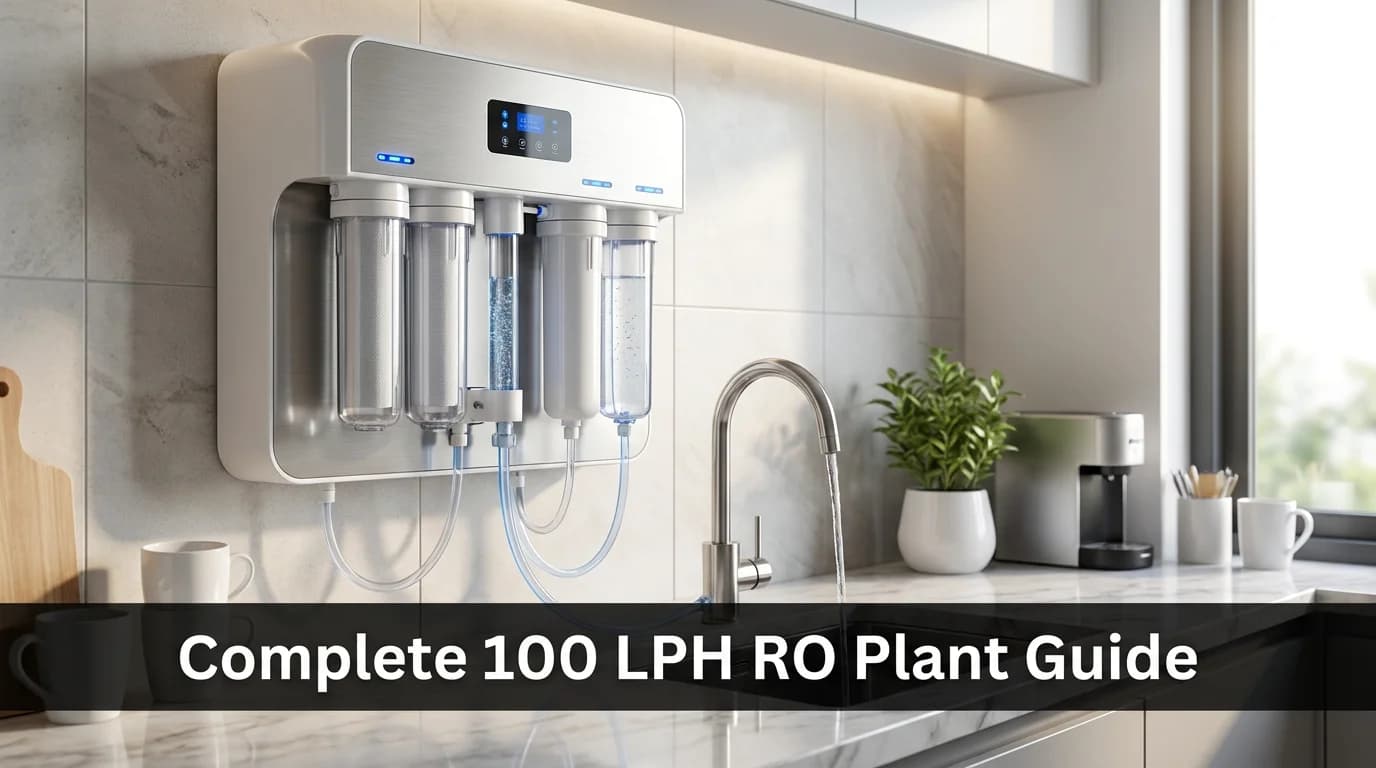
The market offers several 100 lph ro plant configurations tailored to different commercial requirements. Wall-mounted compact systems save floor space in restaurants and cafes where square footage commands premium pricing. These units integrate all components into a sleek cabinet measuring approximately 60 x 45 x 100 centimeters, including storage tanks and dispensing taps. While convenient, compact systems typically require more frequent filter changes due to smaller component sizes.
Floor-standing industrial models provide the best 100 lph ro plant performance for facilities prioritizing longevity and minimal maintenance. These robust systems feature larger pre-filters that handle higher sediment loads, oversized storage capabilities, and easily accessible service panels. Manufacturing facilities, hotels, and hospitals typically prefer floor-standing configurations despite their larger footprint because component accessibility reduces maintenance downtime significantly.
Skid-mounted systems represent the premium tier, where all components mount on a sturdy stainless steel frame with integrated piping and wiring. These plug-and-play installations simplify relocation if your business moves premises, and the organized layout facilitates troubleshooting when issues arise. Though commanding the highest ro plant cost in their category, skid-mounted units deliver unmatched reliability for mission-critical applications where water supply interruptions cannot be tolerated.
Dual-stage and multi-stage reverse osmosis configurations serve locations with extremely contaminated source water. These systems employ two RO membranes in series, achieving TDS reduction above 99 percent and removing even the most persistent contaminants. Pharmaceutical facilities, laboratories, and food processing units often require this level of purification despite the increased operational complexity and electricity consumption.
Installation Considerations for Gurgaon's Commercial Spaces
Proper installation determines whether your ro plant in gurgaon operates efficiently or becomes a constant maintenance headache. Site assessment must evaluate input water pressure, typically requiring minimum 40 PSI for optimal RO membrane performance. Locations with inadequate municipal pressure need booster pumps, while areas with excessive pressure above 80 PSI require pressure reducing valves to prevent component damage.
Electrical infrastructure requires dedicated circuits with appropriate amperage ratings. A 100 lph ro plant typically draws 5 to 8 amperes at 220 volts, necessitating a 16-ampere MCB for safe operation. Voltage stabilizers prove essential in Gurgaon's commercial areas experiencing frequent fluctuations, protecting sensitive electronic controllers and preventing pump motor burnout. Budget an additional INR 3,000 to INR 5,000 for electrical safety components if your facility lacks stable power supply.
Drainage arrangements for reject water deserve careful planning. Connecting reject lines to existing sewage systems works for most installations, but facilities prioritizing water conservation can channel reject water for gardening, floor cleaning, or cooling tower makeup. With approximately 240 liters daily rejection from a 100 liter per hour system operating 8 hours, this reuse significantly reduces environmental impact and municipal water bills.
Space allocation should accommodate not just the ro plant but also storage tanks, service access, and future expansion. Maintain minimum 60 centimeters clearance on all sides for filter replacement and membrane servicing. Adequate ventilation prevents moisture accumulation that could corrode electrical components, particularly important in basement installations common across Gurgaon's commercial complexes.
Maintenance Requirements and Longevity Expectations
Regular maintenance determines whether you enjoy years of trouble-free operation or face frequent breakdowns and expensive repairs. Sediment and carbon pre-filters require replacement every 3 to 6 months depending on input water quality, with costs ranging from INR 800 to INR 1,500 per set. Postponing filter changes forces contamination downstream to the RO membrane, dramatically shortening its lifespan and increasing the overall ro plant cost of ownership.
The RO membrane itself needs annual inspection and replacement every 24 to 36 months under normal operating conditions. Gurgaon's hard water and high TDS levels often necessitate replacement toward the lower end of this range. Membrane costs vary from INR 12,000 to INR 18,000 for quality components, making preventive maintenance through regular pre-filter changes economically sensible.
Professional servicing every three months ensures optimal performance and identifies potential issues before they escalate. Technicians should check system pressure, flow rates, reject water ratios, and output TDS levels during each visit. They sanitize storage tanks, clean filters, adjust pressure settings, and replace worn seals or valves. Annual maintenance contracts typically cost INR 8,000 to INR 15,000, providing peace of mind and priority service when urgent issues arise.
Water quality testing should occur monthly using TDS meters and quarterly through laboratory analysis for comprehensive parameter evaluation. This monitoring confirms your 100 lph ro plant continues delivering safe water and helps identify gradual performance degradation before water quality becomes compromised. Testing kits cost approximately INR 2,000 to INR 5,000 depending on parameters covered.
Making the Right Choice for Your Organization
Selecting the best 100 lph ro plant for your Gurgaon establishment requires balancing immediate budget constraints against long-term operational costs and reliability requirements. Cheaper systems may appear attractive initially but often utilize inferior components that fail prematurely, leading to higher ro plant cost over the system's lifetime. Premium systems with established track records in commercial applications deliver better value through reduced downtime and lower maintenance frequency.
Local support availability should influence your decision significantly. Systems from manufacturers with authorized service centers in Gurgaon ensure rapid response when issues occur, minimizing business disruption. Verify spare parts availability locally, as waiting for components shipped from other cities can leave your organization without purified water for days. Warranty coverage should extend minimum 1 year for components and 5 years for frame construction.
Consider future scalability when making your selection. Organizations experiencing growth may soon outgrow a 100 liter per hour capacity, making modular systems that allow capacity expansion through additional membrane housings a wise investment. Some ro plant in gurgaon installations accommodate capacity doubling by simply adding parallel membrane stages without replacing the entire infrastructure.
Conclusion
Investing in a 100 lph ro plant represents a significant but necessary commitment for commercial establishments in Gurgaon where water quality directly impacts customer satisfaction and employee health. Understanding the technology, carefully evaluating features, and calculating true ro plant cost including operational expenses enables informed decision-making that serves your organization well for years. The best 100 lph ro plant balances initial investment against reliability, efficiency, and maintenance requirements specific to your facility's needs and Gurgaon's challenging water conditions. Whether serving employees in a corporate office or customers in a hospitality venue, a properly selected and maintained commercial reverse osmosis system delivers consistent water quality that protects health and enhances your organization's reputation. Take time to assess your specific requirements, consult with experienced professionals, and choose a system backed by comprehensive local support to ensure your water purification investment delivers maximum value throughout its operational life.