
RO Plant vs Water Purifier: Which One You Should Choose
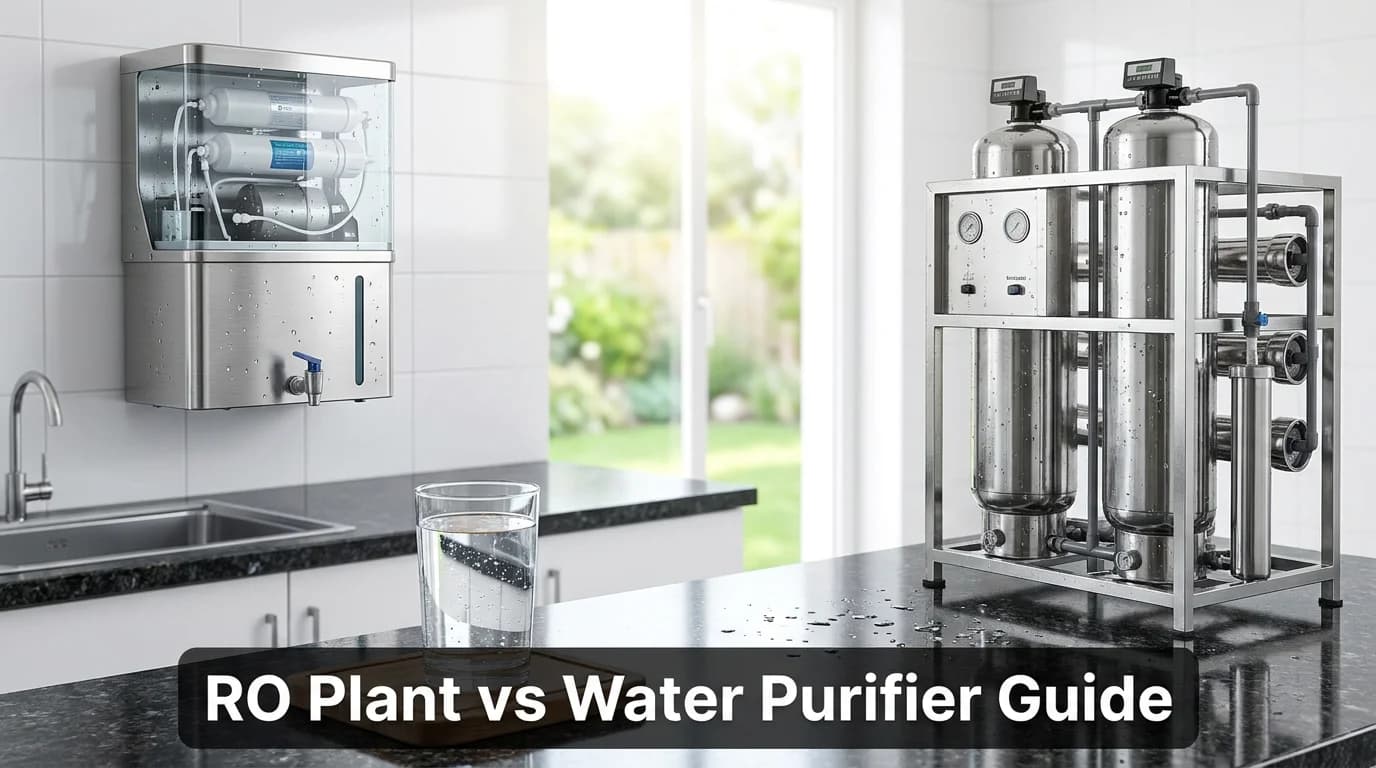
RO Plant vs Water Purifier: Complete Comparison Guide for Your Water Treatment Needs
Choosing the right water treatment solution can feel overwhelming when you're faced with multiple options. Should you invest in a traditional water purifier for your home, or does your situation demand something more robust like an RO plant? This decision impacts not just your water quality but also your budget, maintenance commitments, and long-term satisfaction. Whether you're a homeowner in Gurgaon seeking safe drinking water or a business owner evaluating commercial water treatment options, understanding the fundamental differences between these systems is crucial.
The water purification market in India has evolved significantly over the past decade. What once was a simple choice between boiling water and buying bottled water has transformed into a sophisticated decision involving reverse osmosis technology, varying capacities, and diverse service requirements. An RO plant operates on different principles and scales compared to household water purifiers, serving distinct purposes across residential and commercial settings. Making an informed choice requires examining capacity differences, water quality output, installation complexities, and ongoing service demands.
For many Indian households and businesses, water quality remains a persistent concern. Municipal water often contains dissolved salts, heavy metals, bacteria, and other contaminants that traditional filtration cannot adequately remove. This reality drives people toward advanced purification technologies. Understanding whether a compact home purifier suffices or if you need a 500 lph RO plant depends on multiple factors including daily water consumption, space availability, and budget constraints.
This comprehensive guide breaks down everything you need to know about RO plants versus conventional water purifiers. We'll explore capacity considerations, technology differences, maintenance requirements, cost comparisons, and practical scenarios where each solution shines. By the end, you'll have clarity on which water treatment system aligns perfectly with your specific needs.
Understanding the Fundamental Differences Between RO Plants and Water Purifiers
Water purifiers designed for homes typically handle 10 to 25 liters per hour, serving families of four to eight members comfortably. These compact units mount on walls or sit under counters, requiring minimal space while delivering purified water for drinking and cooking. In contrast, an RO plant represents a scaled-up water treatment facility capable of processing hundreds or thousands of liters hourly. The 500 lph RO plant has become particularly popular among small businesses, restaurants, schools, and housing societies where daily water demand exceeds what residential purifiers can supply.
Technology-wise, both systems employ reverse osmosis principles where water passes through semi-permeable membranes removing dissolved solids, contaminants, and impurities. However, industrial RO plant configurations include multiple pre-treatment stages, larger membrane assemblies, and sophisticated monitoring systems. Home purifiers integrate several technologies—RO combined with UV sterilization, activated carbon filtration, and TDS adjusters—in a single compact unit. Commercial plants separate these processes across distinct modules, allowing independent maintenance and optimization.
The water recovery ratio differs substantially between these systems. Home purifiers typically recover 30 to 50 percent of input water as purified output, with the remainder discharged as reject water containing concentrated contaminants. Properly designed RO plant installations achieve higher recovery ratios through advanced pre-treatment, multiple-pass configurations, and wastewater recycling systems. This efficiency becomes economically significant when processing thousands of liters daily.
Installation complexity separates these options dramatically. A standard home water purifier requires a plumber's half-day work—mounting the unit, connecting inlet-outlet pipes, and establishing drainage for reject water. Setting up an RO plant demands civil work including foundation preparation, plumbing networks, electrical connections, storage tank installation, and sometimes dedicated treatment rooms. Professional installation teams spend several days completing commercial setups, especially for higher-capacity systems.
Capacity Considerations and Daily Water Requirements
Determining appropriate capacity starts with calculating daily water consumption. An average Indian household consumes 15 to 30 liters of purified drinking water daily, easily handled by residential purifiers. Offices with 20 to 50 employees need 100 to 200 liters daily, pushing beyond home purifier capabilities. Restaurants, hotels, and manufacturing facilities consuming 500 to 5000 liters daily require dedicated RO plant installations matching their specific demand patterns.
The 500 lph RO plant occupies a sweet spot for mid-sized commercial applications. Operating continuously, this capacity delivers 12000 liters over 24 hours—sufficient for schools with 500 students, restaurants serving 200 meals daily, or apartment complexes housing 50 families. Scaling beyond this requires modular RO plant systems combining multiple treatment trains, each handling specific capacity segments. This modular approach provides redundancy, allowing partial operation during maintenance periods.
Capacity planning must account for peak demand periods. A restaurant needs maximum purified water during meal times, while offices peak during morning and afternoon hours. Storage tanks bridge the gap between average production capacity and peak consumption, typically sized to hold 2 to 4 hours of peak demand. Residential purifiers include integrated storage tanks of 8 to 15 liters, whereas commercial RO plant setups feature separate storage systems ranging from 500 to 10000 liters depending on application requirements.
Seasonal variations affect capacity planning significantly. Summer months see 20 to 40 percent higher water consumption across residential and commercial settings. Smart capacity selection includes headroom for such fluctuations, preventing system overload and ensuring consistent water availability during demand spikes. Under-sizing leads to water shortages and frustrated users, while over-sizing wastes capital investment and increases operating costs unnecessarily.
Service Requirements and Maintenance Complexity
Regular RO plant service constitutes a critical operational requirement often underestimated during initial purchase decisions. Home water purifiers need quarterly or half-yearly service visits including filter replacements, membrane cleaning, and system sanitization. These services cost between 1500 to 3500 rupees annually depending on brand and service provider. Commercial RO plant installations demand more frequent attention—monthly inspections, filter changes every 3 to 6 months, membrane replacements annually or bi-annually, and daily operational monitoring.
Finding reliable RO plant service in Gurgaon or any major city involves evaluating service provider credentials, response times, spare parts availability, and technical expertise. Commercial installations benefit from Annual Maintenance Contracts covering scheduled preventive maintenance, emergency breakdowns, consumable replacements, and performance optimization. AMC costs for a 500 lph RO plant typically range from 35000 to 75000 rupees annually based on system complexity and service scope.
Pre-treatment maintenance significantly impacts RO plant longevity and performance. Multi-media filters, activated carbon filters, and softeners protecting RO membranes require backwashing, media replacement, and regeneration. Residential purifiers integrate simpler pre-filters needing quarterly changes. Neglecting pre-treatment accelerates membrane fouling, reducing efficiency and increasing operational costs. Commercial plants often employ automatic backwashing systems reducing manual intervention but demanding proper programming and monitoring.
Water quality monitoring distinguishes professional RO plant operations from casual residential purifier usage. Commercial installations benefit from TDS meters, pressure gauges, and flow monitors providing continuous performance data. This monitoring enables predictive maintenance, identifying developing issues before system failures occur. Some modern RO plant setups include IoT-enabled remote monitoring, allowing service teams to track performance parameters and schedule interventions proactively.
Cost Analysis: Initial Investment and Operating Expenses
Understanding total cost of ownership guides intelligent purchasing decisions. Home water purifiers cost between 8000 to 35000 rupees depending on capacity, technology, and brand positioning. Installation adds another 1000 to 3000 rupees. A 500 lph RO plant represents significantly higher initial investment—250000 to 800000 rupees including equipment, installation, civil work, and commissioning. This disparity reflects capacity differences, component quality, and system complexity.
Operating costs include electricity consumption, consumable replacements, service charges, and membrane replacements. A residential purifier consumes 25 to 60 watts, adding 100 to 200 rupees to monthly electricity bills. Commercial RO plant power consumption varies with capacity—a 500 lph unit typically draws 2 to 5 kilowatts, translating to 3000 to 8000 rupees monthly depending on operating hours and local electricity rates. Water wastage costs must be factored, especially in areas with expensive municipal water supply.
Per-liter purified water cost provides meaningful comparison. Home purifiers deliver water at approximately 0.40 to 0.80 rupees per liter considering all expenses. Well-maintained RO plant installations achieve 0.20 to 0.50 rupees per liter at higher capacities due to economies of scale. However, poorly maintained plants with frequent breakdowns and excessive reject water can exceed 1.50 rupees per liter, becoming economically unviable compared to alternative water sources.
Return on investment timelines vary dramatically. For commercial applications replacing bottled water purchases, a 500 lph RO plant typically recovers initial investment within 18 to 36 months through operational savings. Residential purifiers show immediate savings compared to ongoing bottled water expenses, recovering costs within 6 to 12 months for regular users. These calculations assume normal operation, adequate maintenance, and reasonable input water quality requiring standard treatment protocols.
Choosing the Right Solution for Different Scenarios
Residential applications almost universally favor conventional water purifiers unless dealing with unusually large joint families or independent villas housing multiple generations. A well-selected home purifier handles 4 to 8 person households efficiently, occupying minimal space while delivering adequate capacity. Attempting RO plant installation in typical residential settings creates unnecessary complexity, excessive capacity, and disproportionate costs without corresponding benefits.
Small businesses, restaurants, and cafes serving 50 to 200 customers daily represent ideal candidates for compact RO plant installations. The 500 lph capacity matches their requirements perfectly, eliminating bottled water procurement hassles, reducing operational costs, and ensuring consistent quality. These establishments benefit from dedicated water treatment avoiding dependency on external suppliers while maintaining stringent hygiene standards their operations demand.
Educational institutions, hospitals, and large office complexes consuming thousands of liters daily require appropriately scaled RO plant configurations. Modular systems combining multiple treatment trains provide required capacity with built-in redundancy. These installations justify dedicated operators, sophisticated monitoring systems, and comprehensive maintenance programs ensuring uninterrupted supply to hundreds or thousands of daily users.
Housing societies face unique considerations. Centralized RO plant installations serving entire communities offer economies of scale, professional maintenance, and consistent quality. However, distribution infrastructure, usage monitoring, and cost recovery mechanisms add complexity. Some societies prefer decentralized approaches encouraging individual apartment owners to install home purifiers, simplifying management but sacrificing collective bargaining power and standardization benefits.
Conclusion
Selecting between an RO plant and conventional water purifier fundamentally depends on scale, usage patterns, and specific application requirements. Home purifiers excel in residential settings providing convenient, compact, cost-effective solutions for families. Commercial RO plant installations become essential when daily consumption exceeds 100 liters, offering capacity, efficiency, and economics impossible with residential equipment. The 500 lph RO plant specifically addresses mid-sized commercial needs perfectly, balancing capacity with manageable investment.
Success with either solution requires understanding service requirements, budgeting for ongoing maintenance, and ensuring reliable RO plant service availability in your area. Cities like Gurgaon with developed service infrastructure support commercial installations effectively, while smaller towns may face service challenges making simpler residential purifiers more practical. Calculate total ownership costs including initial investment, operating expenses, and service charges before committing to ensure your chosen solution aligns with both immediate needs and long-term operational realities.
Ultimately, water quality should never be compromised regardless of which system you choose. Both RO plants and water purifiers deliver safe, purified water when properly selected, installed, and maintained. Your decision should reflect honest assessment of consumption requirements, available space, budget constraints, and willingness to manage ongoing maintenance commitments. Choose wisely, maintain diligently, and enjoy the peace of mind that comes with reliable access to pure, safe drinking water for years to come.
Explore further how RO plants and water purifiers differ in filtration capacity, maintenance needs, and cost efficiency to make an informed decision. Learn more about water quality testing methods that reveal which solution matches your specific contamination levels and household requirements for optimal long-term performance.