Select Service


.webp&w=256&q=75)
Everything you need to know
Lakshadweep relies on a combination of desalinated water produced through reverse osmosis plants and groundwater sources. While desalinated water sounds pure, it still contains dissolved minerals, and certain islands draw from brackish aquifers where salinity levels remain high even after municipal treatment. When tap water carries elevated TDS (Total Dissolved Solids) or salt content, the RO membrane inside your home purifier has to work substantially harder than it would in regions with naturally soft water.
This workload directly affects how quickly filters become saturated and how soon the RO membrane loses efficiency. A sediment pre-filter that might last six months on mainland municipal supply can become clogged in four months when processing water with higher mineral loads. Similarly, the RO membrane itself — the heart of your purification system — experiences faster degradation under constant exposure to high-salinity water. Recognizing these island-specific pressures helps you understand why service intervals on Lakshadweep may differ from national averages.
Rather than waiting for visible failure, regular monitoring of your purifier's behaviour helps catch declining performance early. This is particularly important in Lakshadweep, where replacing a damaged purifier or having a non-functional unit for several days can be especially disruptive.
Pay attention to these specific indicators:
Standard filter replacement timelines printed in manuals assume average municipal water quality. Lakshadweep's water profile demands more aggressive replacement schedules in most cases.
Sediment pre-filter: In mainland cities, this typically lasts four to six months. On Lakshadweep, depending on which island and water source you use, plan for replacement every three to four months. Higher sediment loads and mineral-heavy water saturate the filter faster.
Carbon filter: Standard guidance suggests six to eight months. For Lakshadweep households with high-TDS water, consider replacement every four to six months to maintain taste and odor control.
RO membrane: This is where island conditions make the biggest difference. Mainland users often see 18 to 24 months of membrane life. In Lakshadweep, especially if you're drawing from brackish sources or areas with desalination-treated water, effective membrane life often drops to 12 to 18 months. The continuous exposure to dissolved salts and minerals accelerates fouling and membrane degradation.
Post-carbon filter: Usually replaced annually, this timeline remains similar across regions since it's a final polishing stage.
Rather than treating these as fixed schedules, view them as starting points. A technician familiar with your specific island's water supply can make more precise recommendations during a service visit.
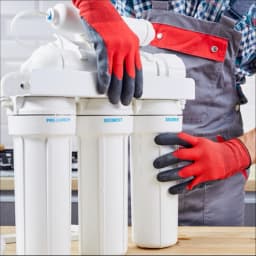
During a typical Eureka Forbes service visit, the technician performs a structured sequence to identify both immediate issues and emerging problems:
Service charges in Lakshadweep reflect several island-specific variables that differ from mainland pricing:
Parts logistics. Replacement filters and RO membranes sometimes need to be sourced from the mainland or ordered specifically for island delivery. This can affect parts costs and availability timelines compared to cities where spare parts stock is readily accessible locally.
Technician availability and travel. If you're on one of the smaller islands, a technician may need to coordinate travel time and scheduling differently than in densely populated urban centers. Some service providers factor this into visit charges.
Water profile-specific parts. Some Eureka Forbes models designed for high-TDS water use different filter media or membrane types than standard units. Using the correct parts for your water conditions may carry slightly different pricing than generic alternatives.
AMC coverage scope. An AMC plan on Lakshadweep may be structured differently — for instance, covering more frequent filter replacements by default due to island conditions, but potentially with different response-time guarantees given geographic constraints.
Before scheduling service, describe your island location and water issues when getting a quote. This gives the provider context to offer an accurate estimate rather than a generic one based on mainland assumptions.
An Annual Maintenance Contract makes particular sense for Lakshadweep residents, since it converts unpredictable service costs into a fixed budget item and ensures your purifier receives attention even if you're preoccupied with island life.
A comprehensive AMC plan typically includes:
When an AMC plan makes less sense: If your purifier is brand new and covered under manufacturer warranty, postpone an AMC until warranty expires. If you're renting and unsure of your housing timeline, a pay-per-visit arrangement might be more practical than committing to an annual contract.
Reading the fine print matters: Confirm whether the AMC plan you're considering accounts for Lakshadweep's water conditions with appropriate filter replacement frequency. Some generic plans designed for mainland use may promise fewer visits or replacements than your island water actually needs.
Certain problems appear more frequently in Lakshadweep than elsewhere due to environmental factors:
Mineral scaling on internal components. High-salinity water deposits mineral coatings inside pipes, valves, and the storage tank. This requires more aggressive cleaning during service visits and occasional descaling chemical treatments, which differ from standard filter changes.
Seasonal variation in water quality. During monsoon months, municipal water sources may become more dilute, causing different stress patterns on your purifier. Conversely, dry-season water can become saltier. A good service plan adjusts technician visit timing to match these seasonal patterns.
Salt creep and corrosion. The island's saline air and occasional moisture can cause external corrosion on the purifier's metal components faster than in continental settings. Routine wiping and protective measures help, but technicians should check for corrosion during service visits.
Power supply disruptions. Island locations sometimes experience irregular power supply or voltage fluctuations. A technician can identify whether electrical surge damage or brownout effects are affecting your purifier's performance.
Locating an Eureka Forbes service provider on an island requires a different approach than searching a city directory. A few practical steps help you identify capable technicians:
Start by contacting the Eureka Forbes customer care line and asking whether they have authorized service partners operating in your specific island. Authorized partners have access to genuine parts, proper training, and warranty support that independent technicians may not have. Response time may be longer than in mainland cities, but this route ensures quality and accountability.
If authorized service isn't available within reasonable timeframe for your island, ask for recommendations within your residential community. Neighbours who have had purifiers serviced recently can tell you whether providers they used were reliable, honest about parts replacement, and available on your island.
When contacting a service provider, be specific: mention your island location, describe your water quality concerns (taste, TDS if you've had it tested, any visible issues), and ask what their typical response time is. A provider familiar with island work will give practical answers rather than generic mainland timelines.
Avoid choosing based solely on lowest quoted price. A cheaper quote that results in your purifier breaking down again in two months costs far more in the long run than a slightly higher investment with a provider who understands island water conditions and stands behind their work.
Beyond professional service, your own actions keep the purifier running longer between visits:
What makes us different
Lakshadweep's water supply faces challenges that mainland cities seldom encounter. The combination of desalinated municipal water, high mineral content, and saline ingress in certain areas places unique stress on reverse osmosis systems. An Eureka Forbes purifier that performs reliably in Delhi might need more frequent maintenance when dealing with Lakshadweep's water composition.
Island residents depend entirely on their purifiers for safe drinking water, making timely service and preventive maintenance not just a convenience but essential. Understanding how Lakshadweep's water environment affects your system helps you budget for service, choose the right maintenance plan, and keep your household water supply uninterrupted year-round.
Step-by-step guidance
Don't wait! Get the Best water purifier service at the most competitive rates. Contact rocareindia today for a free consultation and quote.

Verified Professionals

Work Assurance

On-Time Support

Covid-19 Safety
Find answers to common questions about our services
Pure water, delivered.