
Indore Water Contamination Tragedy | Sewage-Linked Diarrhoea Outbreak Kills 23, Exposes Urban Negligence
🚨 Overview: Indore’s Water Contamination Disaster
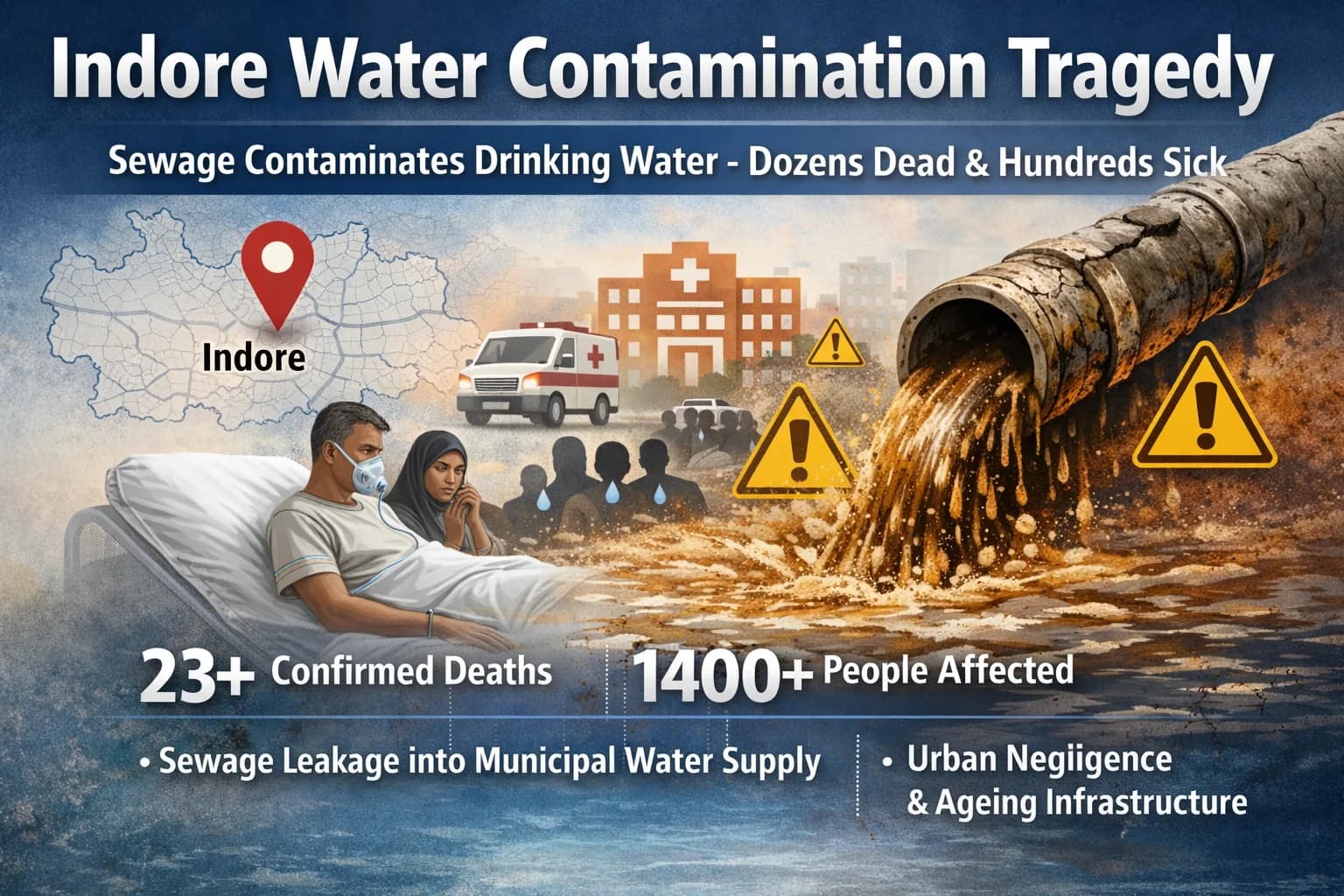
A major public health emergency has struck Indore, Madhya Pradesh, often celebrated as India’s cleanest city. In a tragic turn, sewage contamination in the municipal drinking water network caused a deadly outbreak of diarrhoeal disease, killing at least 23 residents — including children and senior citizens — and sickening over 1,400 people.
The epicenter of the outbreak was the Bhagirathpura area, where residents began reporting severe symptoms such as vomiting, fever, and dehydration after consuming contaminated tap water.
💧 Root Cause: Sewage Leakage into Drinking Water Pipelines
Investigations revealed that the contamination originated from a toilet built directly above a key water pipeline near a local police check post.
This reckless construction allowed sewage to seep into the main water supply, turning household taps into sources of infection.
Key Findings:
Bacterial contamination confirmed by lab tests.
Unlined waste pits and poor drainage planning by contractors attempting to cut costs.
Pipelines laid dangerously close to sewer lines, violating safety codes.
This combination of negligence and infrastructure decay transformed the city’s water supply system into a deadly hazard overnight.
👨👩👧 Human Impact: 1,400+ Infected, 23 Confirmed Deaths
Over 27 hospitals in Indore were flooded with patients suffering from dehydration, vomiting, and high fever.
Families, including that of a five-month-old infant victim, reported no advance warnings about contamination even after filtering water.
The crisis disproportionately affected low-income neighborhoods, forcing residents to rely on RO filters, borewells, and bottled water as fear spread across the city.
Initial death tolls varied between 6 and 10, but official reports later confirmed 23 fatalities directly linked to the outbreak through post-mortem and medical affidavits.
🏛️ Government Action & Accountability
Authorities have suspended multiple municipal officials, dismissed one, and initiated a comprehensive pipeline repair operation.
Emergency measures include:
Distribution of clean water through tankers and alternate pipelines.
Free treatment for affected families.
Deactivation of 51 contaminated tubewells.
High-profile visits — including Congress leader Rahul Gandhi’s meeting with victims — intensified calls for accountability and anti-corruption reforms in Indore’s civic administration.
Experts and critics describe the event as a “system-created disaster” caused by urban mismanagement, corruption, and cost-cutting in infrastructure development.
🧠 Lessons from the Indore Water Crisis
The tragedy underscores the urgent need for:
Regular pipeline audits and water quality checks.
Strict urban planning enforcement to prevent illegal construction near utility lines.
Public awareness campaigns on safe water usage and filtration.
Transparent accountability systems for contractors and municipal engineers.
🔑 Key Takeaways
Location: Indore, Madhya Pradesh
Cause: Sewage seepage from toilet over water pipeline
Casualties: 23 deaths, 1,400+ affected
Response: Officials suspended, tubewells closed, repair and testing underway
Keywords: Indore water tragedy, sewage contamination, waterborne disease, diarrhoea outbreak, clean city Indore, water pollution India
📢 Conclusion
The Indore water contamination tragedy is a wake-up call for every Indian city aspiring to urban excellence. Despite Indore’s “Cleanest City of India” title, this preventable disaster reveals deep cracks in infrastructure management, water safety protocols, and accountability systems.
Unless authorities strengthen urban water governance, tragedies like this will continue to endanger lives in the name of development.