
Select Service




.webp&w=256&q=75)
What makes us different
Ghaziabad's water supply carries challenges that many other Indian cities don't face equally. Proximity to the Yamuna river and reliance on groundwater from industrial zones means local water is laden with dissolved salts, heavy metals, and sediment that municipal treatment alone does not fully remove. Reverse osmosis purifiers work harder here than they might elsewhere, which means filters clog faster and membranes degrade sooner. Without regular servicing, your RO unit will struggle to deliver genuinely safe drinking water within months.
A neglected purifier becomes inefficient long before it breaks down altogether. It produces slower flow, lets through TDS levels that should be blocked, and puts strain on internal pumps that eventually fail. The cost of ignoring maintenance is far higher than the cost of staying on top of it.
Download App & Earn Coins
Your Welcome Bonus:
1000 Coins
*Coins can be redeemed on services
Everything you need to know
Understanding why your purifier needs frequent attention starts with understanding what's in your tap water. Ghaziabad's supply combines municipal water from treatment plants with groundwater that often carries high TDS levels — sometimes exceeding 800 mg/L, especially during summer months. Added to this are industrial discharge, agricultural runoff, and seasonal turbidity spikes before and after monsoon season.
When an RO system filters this kind of water continuously, the sediment and mineral load accumulates in the pre-filters far faster than it would in areas with cleaner supply. The carbon filters get saturated with chlorine and organic compounds sooner. The membrane itself experiences higher osmotic pressure from all the dissolved salts, forcing it to work beyond its designed efficiency. Delaying service under these conditions doesn't just reduce water quality — it actually shortens the lifespan of expensive internal parts.
Most families don't schedule service until something stops working entirely. Instead, watching for these specific signs gives you time to book a technician before the unit becomes unreliable:
In high-pollution areas like Ghaziabad, these issues develop faster than in other regions. Acting on them quickly keeps repair costs lower.
Ghaziabad has no shortage of repair services advertising quick fixes, but several qualities separate reliable technicians from those who cut corners:
Service costs vary based on several factors that are worth understanding before you call a technician:
The type of work required. A routine pre-filter replacement costs significantly less than a full membrane replacement or pump repair. Because Ghaziabad's water is demanding, you're more likely to need filter replacements than households in other cities.
Which filters or components actually need replacing. A sediment filter is inexpensive, but an RO membrane is a major cost. A diagnostic visit can clarify exactly what your unit needs before you commit to paying.
Whether your unit is still under warranty. New purifiers or those still under active manufacturer warranty may have repair or replacement costs covered entirely. Confirming warranty status using your purchase invoice or product registration saves you from paying for work that may be free.
The condition of the overall unit. If a purifier hasn't been serviced in over a year, the technician may need to perform deep cleaning of the storage tank or replace multiple stages at once, raising the total bill compared to regular preventive maintenance.
Local labor rates and competition. Different neighborhoods and different technicians in Ghaziabad may charge varying rates. Comparing quotes from two or three providers before deciding is always worthwhile.
Rather than accepting the first quote, request a written estimate that itemizes what work will be done and what it will cost. This protects both you and the technician by setting clear expectations.
When your purifier needs attention, you face a choice: pay for individual service visits as problems arise, or enroll in an annual maintenance contract that covers scheduled servicing and many repairs for a fixed yearly fee.
An AMC plan typically includes two or more scheduled visits per year, filter replacements during those visits, and coverage for minor repairs like valve replacements or connector tightening. You pay one annual fee upfront and avoid surprise bills later.
If your water comes from a borewell with particularly high TDS, or if your household uses large quantities of purified water daily, an AMC plan spreads the cost predictably across the year and ensures filters get replaced on a tight schedule before water quality drops. It also guarantees priority scheduling during monsoon and pre-monsoon periods when RO problems spike.
If your purifier is brand new and covered by manufacturer warranty, or if you're uncertain you'll stay in your current home or continue using the purifier, paying for each service individually keeps your cash outflow lower upfront. Some households also choose this option if they use the purifier lightly and experience few issues year-round.
Before committing to an AMC, read exactly what is included. Some plans cover unlimited visits but charge separately for filters. Others bundle everything into one price. Clarifying these details prevents frustration when you actually need a repair.
Standard filter life recommendations assume average water quality. In Ghaziabad, where TDS and contamination levels are above-average, replacement intervals are typically shorter:
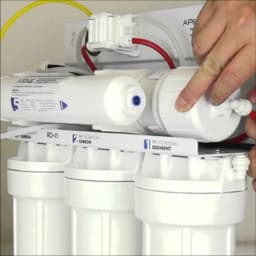
Sediment pre-filter (the first stage). This traps large particles, sand, and rust from the supply. In Ghaziabad's conditions, replacement is often needed every 3 to 4 months rather than the usual 6 months. Neglecting this stage clogs the later filters prematurely.
Carbon filter (the second stage). It removes chlorine, odor, and some dissolved organic matter. Here, expect to replace every 5 to 6 months, sometimes sooner if the water has been unusually turbid or if summer water pressure causes accelerated flow-through.
RO membrane (the core filtration step). This does the heavy lifting of removing dissolved salts and impurities. In typical Indian conditions, membranes last 12 to 18 months. In Ghaziabad, particularly hard water areas, 9 to 12 months is more realistic, and some households in very high-TDS zones need replacement every 6 to 9 months.
Post-carbon filter (final stage). This polishes the water just before it reaches your glass. Annual replacement is standard, though Ghaziabad's heavier contamination sometimes calls for more frequent changes.
Keeping a written log of when you last replaced each filter prevents guesswork and helps you spot unusual wear patterns. If you're replacing the carbon filter after just four months when it should last five or six, it signals a change in your water quality that the technician should know about.
Understanding the service workflow helps you evaluate whether work is being done thoroughly:
The technician begins by noting the current complaints — slow flow, unusual taste, leaks, or noise. He or she then checks the TDS meter reading and water flow rate to establish a baseline before any work begins. This baseline matters because it gives you concrete evidence of whether service has actually improved performance.
Next comes inspection. Each filtration stage is examined to assess how much sediment or mineral buildup has accumulated. The storage tank is inspected for any leaks or internal signs of bacterial growth or rust. Fittings and seals are checked for cracks or looseness. The pump is tested to confirm it's running at normal pressure.
Based on this inspection, the technician identifies which components actually need replacement. Good service providers do not automatically replace all filters — they replace only what is worn. This keeps costs fair and avoids unnecessary waste.
During replacement, the unit is usually isolated from the water supply and the storage tank is drained. Each new filter is fitted carefully, with all connections double-checked for tightness. The storage tank may also be cleaned or sanitized to prevent bacterial buildup, which is important in Ghaziabad's high-contamination environment.
After installation, the system is flushed to clear any carbon dust or manufacturing residue from new filters. The technician then tests water flow, TDS output, and checks for leaks. The purifier should perform measurably better after service compared to before.
A professional technician leaves you with a written receipt documenting what was replaced, when the next service is due, and any advice specific to your unit or water conditions. This record is useful for warranty claims and helps you track long-term maintenance patterns.
Several habits help keep your purifier running and reduce how often repairs become necessary:
Do not run the unit when the inlet water supply is depleted or the incoming pressure is extremely low. This strains the pump and can cause damage. During summer, when pressure may be reduced, monitor whether your purifier is getting adequate input before leaving it running unattended.
Clean the outer surface and the tap regularly to prevent dust and mineral deposits from building up around fittings. Ghaziabad's industrial area means airborne dust is heavier than in some other cities.
Pay attention to indicator lights or TDS readings if your model includes them. These are not warnings to ignore — they tell you when a filter is nearing the end of its usable life. Acting on these signals prevents the kind of deterioration that requires expensive component replacement.
Ensure the area immediately around your purifier has good ventilation. Purifiers generate some internal heat, and in Ghaziabad's hot summers, poor ventilation can stress plastic components or reduce the efficiency of cooling mechanisms inside certain models.
If you travel for extended periods and won't be using the purifier, shut off the inlet water supply to avoid pressure buildup in the storage tank or unnecessary stress on seals. When you return, allow the unit to run briefly to clear any water that may have stagnated.
When problems arise, you have multiple options for getting help. The official Eureka Forbes customer care channel handles warranty queries, product registration, and complaints — most households keep this number accessible for exactly these reasons. For warranty-covered issues, official channels ensure you're not paying for work that should be free.
For routine maintenance, filter changes, or non-warranty repairs, many households in Ghaziabad rely on independent technicians who specialize in RO systems. These specialists often respond faster for same-day or next-day service, especially for non-urgent work like scheduled filter replacement. The trade-off is that you're responsible for evaluating their expertise rather than relying on the brand's guarantee.
Knowing whether your issue is covered under warranty before you call saves time. Check your original invoice, product registration confirmation, or the warranty card that came with your purifier. Warranty typically covers manufacturing defects but not wear-and-tear or damage from neglect.
Ghaziabad's water challenges won't disappear, but proactive maintenance keeps them from becoming urgent crises. The most effective approach combines three practices: staying on top of filter replacement schedules, watching for early warning signs like taste changes or flow reduction, and choosing a service provider who understands local water conditions. A slightly higher service charge from an experienced technician often saves money compared to repeated visits from someone who misdiagnoses problems or replaces parts unnecessarily. Your goal is safe, consistent drinking water without unexpected downtime. Staying intentional about maintenance gets you there.
Step-by-step guidance
Don't wait! Get the Best water purifier service at the most competitive rates. Contact rocareindia today for a free consultation and quote.

Verified Professionals

Work Assurance

On-Time Support

Covid-19 Safety
Find answers to common questions about our services
Pure water, delivered.