
RO vs UV vs UF: Which Water Purifier is Best for Vijayawada Water?
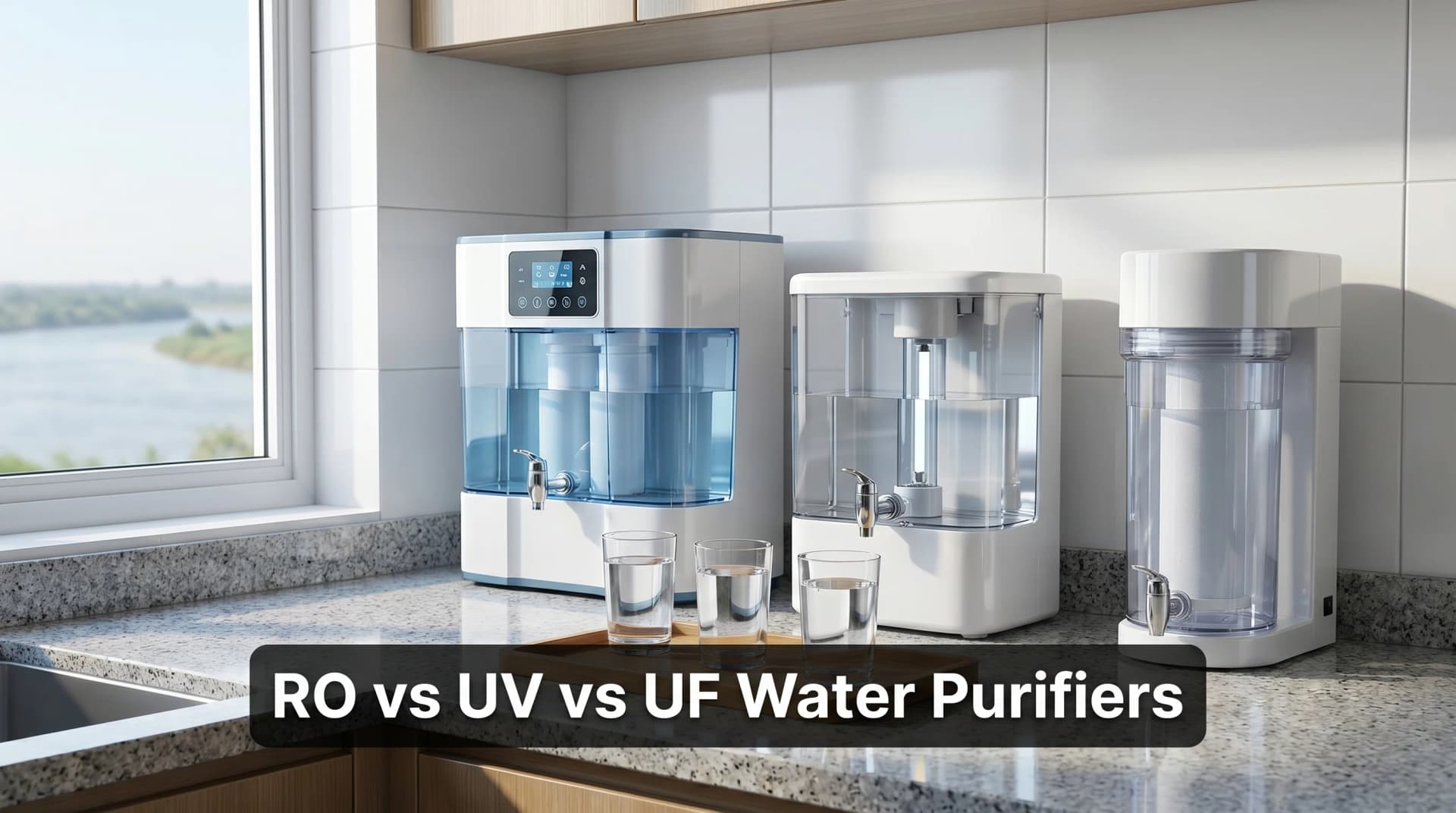
RO vs UV vs UF Water Purifiers: Complete Technology Guide for Vijayawada Homes
Water quality concerns have become a growing priority for families across Vijayawada as the city continues to expand and industrial activities increase around residential areas. The Krishna River water supply that reaches most homes undergoes significant variation in quality depending on seasonal changes and distribution networks. Choosing between RO, UV, and UF water purification technologies represents one of the most important decisions for your family's health, yet many homeowners remain confused about which system truly matches their specific water requirements. With varying TDS levels, bacterial contamination risks, and mineral content across different areas of Vijayawada, understanding the fundamental differences between these three purification methods becomes essential before making an investment.
The selection process becomes even more critical when you consider that improper technology choice can either waste water resources through unnecessary purification or fail to remove harmful contaminants adequately. Residents in areas like Benz Circle, Gunadala, and Patamata often report different water quality issues, making a one-size-fits-all recommendation impractical. Additionally, the availability of reliable ro service vijayawada plays a crucial role in maintaining long-term purifier performance, as even the best technology requires proper maintenance and timely filter replacements. This comprehensive guide examines each purification technology in detail, helping Vijayawada residents make informed decisions based on their specific water quality parameters and household requirements.
Before committing to any water purifier purchase, getting your water tested for TDS levels, hardness, microbial contamination, and chemical impurities provides the foundation for smart decision-making. Many families discover after installation that they chose the wrong technology, resulting in wasted money and continued health risks. Understanding how RO, UV, and UF technologies work, their respective strengths and limitations, and which water conditions they address best empowers you to select the perfect purification system for your home.
The relationship between water quality and purification technology extends beyond simple filtration—it involves understanding flow rates, storage capacity, power consumption, maintenance requirements, and long-term operational costs. With proper guidance and access to professional ro water purifier service vijayawada, your chosen system can provide safe drinking water for years while adapting to seasonal water quality changes common in this region.
Understanding Reverse Osmosis Technology for High TDS Water
Reverse Osmosis purification technology operates through a semi-permeable membrane that removes dissolved salts, heavy metals, chemicals, and microorganisms from water by applying pressure to force water molecules through microscopic pores. This process effectively reduces TDS levels from 1500-2000 ppm down to 50-80 ppm, making it ideal for Vijayawada areas receiving borewell water or municipal supply with high mineral content. The RO membrane typically measures 0.0001 microns, small enough to block even dissolved impurities that other technologies cannot address.
The RO purification process involves multiple stages including pre-filtration through sediment and carbon filters, the RO membrane stage, and post-filtration for taste enhancement. During operation, the system separates input water into purified water and reject water containing concentrated impurities. The rejection ratio typically ranges from 50-75 percent, meaning that for every liter of purified water produced, 1-3 liters get rejected as waste. This water wastage represents the primary environmental concern with RO technology, though modern systems have improved efficiency considerably.
RO purifiers prove most beneficial for specific water quality scenarios common across Vijayawada neighborhoods. High TDS water exceeding 500 ppm contains excessive dissolved minerals that affect taste and potentially harm health over long-term consumption. Areas receiving groundwater supply often face this challenge, with TDS levels sometimes reaching 1500-2500 ppm during summer months. RO technology also removes fluoride, arsenic, lead, nitrates, and pesticides that occasionally contaminate water sources near agricultural or industrial zones.
However, RO systems require consistent maintenance through reputable ro service in vijayawada providers to function optimally. The pre-filters need replacement every 6-8 months, while the RO membrane typically lasts 2-3 years depending on input water quality and usage volume. Pressure requirements mean that low-pressure water supply areas may need booster pumps, adding to installation and operational costs. Additionally, RO purified water loses beneficial minerals like calcium and magnesium, which some systems address through remineralization cartridges in post-filtration stages.
UV Purification Technology for Low TDS Microbiologically Contaminated Water
Ultraviolet purification technology uses UV-C light radiation at 254 nanometers wavelength to deactivate bacteria, viruses, and other microorganisms by damaging their DNA structure, rendering them unable to reproduce or cause infections. Unlike RO technology, UV purification does not remove any dissolved solids or change the chemical composition of water—it specifically addresses biological contamination. The UV lamp enclosed in a quartz sleeve allows water to flow around it, exposing microorganisms to germicidal radiation for effective disinfection without adding any chemicals or altering water taste.
UV purifiers operate most effectively when input water has TDS levels below 500 ppm and is free from turbidity or cloudiness. Suspended particles can create shadows that protect microorganisms from UV exposure, reducing purification effectiveness. This makes UV technology particularly suitable for Vijayawada areas receiving municipal corporation supply that undergoes pre-treatment but may face bacterial contamination during distribution through aging pipelines. Localities like MG Road, Governorpet, and parts of Bhavanipuram typically receive relatively low TDS water that benefits from UV treatment rather than RO processing.
The operational advantages of UV purification include zero water wastage, no chemical addition, relatively low maintenance requirements, and retention of natural minerals beneficial for health. The UV lamp requires replacement annually or after approximately 8000-9000 hours of operation, representing the primary recurring cost. Power consumption remains minimal at 40-60 watts, and the purification process maintains natural water taste without the slightly flat taste sometimes associated with RO water. Installation simplicity and compact design make UV purifiers space-efficient options for smaller kitchens.
However, UV technology limitations must be clearly understood before selection. It cannot remove dissolved salts, heavy metals, fluoride, nitrates, or chemical contaminants—only biological threats. Water with TDS above 500 ppm tastes unpleasant and may cause health issues regardless of UV treatment. Cloudy or turbid water reduces UV effectiveness significantly, requiring pre-filtration through sediment filters. The system requires continuous electricity supply during purification, and lamp failure means zero purification without any visible indication until the replacement indicator activates. Professional ro customer care vijayawada services typically handle all purification technologies, ensuring proper installation and maintenance regardless of your chosen system.
UF Technology for Basic Purification Without Electricity
Ultrafiltration technology employs hollow fiber membranes with pore sizes around 0.01 microns to physically block bacteria, cysts, and suspended particles while allowing dissolved salts and minerals to pass through. UF purification operates purely on water pressure without requiring electricity, making it suitable for areas facing frequent power cuts or locations without reliable electricity access. The membrane structure consists of thousands of microscopic fibers with tiny pores that trap contaminants larger than the pore size through mechanical filtration.
UF purifiers work best for water sources with TDS below 200 ppm and minimal chemical contamination, providing basic protection against biological threats and particulate matter. The technology removes turbidity, bacteria, and cysts effectively while maintaining water's natural mineral composition and taste. Flow rates remain higher than RO systems because no pump operates against membrane resistance, and zero water wastage occurs during the purification process. This makes UF environmentally friendly and cost-effective for basic purification needs.
The application scenarios for UF technology typically involve rural areas, vacation homes, or as pre-treatment stages in multi-stage purification systems. In Vijayawada context, UF alone rarely suffices for main drinking water purification due to TDS levels generally exceeding 200 ppm, but it serves well as a first-stage filter protecting RO or UV components from premature damage. The membrane requires backwashing every few days to prevent clogging and maintains effectiveness for 1-2 years before replacement becomes necessary.
UF limitations include inability to remove dissolved salts, inability to eliminate viruses smaller than pore size, and dependence on adequate water pressure for reasonable flow rates. Chemical contamination passes through completely untreated, and taste improvement remains minimal if the source water has high dissolved solids. For comprehensive purification in Vijayawada conditions, UF typically combines with other technologies rather than functioning as a standalone solution.
Technology Comparison and Selection Criteria for Vijayawada Water
| Technology | TDS Reduction | Bacteria Removal | Chemical Removal | Electricity Required | Water Wastage | Best For Vijayawada Areas |
|---|---|---|---|---|---|---|
| RO | Excellent (Up to 90%) | Excellent | Excellent | Yes | 50-75% | Borewell, High TDS zones |
| UV | None | Excellent | None | Yes | Zero | Municipal supply areas |
| UF | None | Good | None | No | Zero | Pre-filtration stage |
Selecting the appropriate purification technology for your Vijayawada home requires analyzing several factors beyond just the technology itself. Water source type represents the starting point—borewell water typically demands RO purification due to high TDS and potential chemical contamination, while treated municipal water often requires only UV or combination systems. Getting water tested through government laboratories or private testing facilities provides specific TDS readings, hardness levels, and contamination reports that guide technology selection accurately.
Family size and daily water consumption influence system capacity requirements, with larger households needing higher flow rates and larger storage tanks. A family of four typically consumes 15-20 liters of purified drinking and cooking water daily, requiring systems with adequate production capacity and storage. Power availability matters significantly—frequent power cuts necessitate larger storage capacity or UF components that function without electricity. Areas like Ajit Singh Nagar and parts of Autonagar experiencing extended power disruptions benefit from systems with substantial storage tanks.
Budget considerations extend beyond initial purchase price to include annual maintenance costs, filter replacement expenses, electricity consumption, and water wastage costs. RO systems generally cost more upfront and require the most frequent maintenance through ro service vijayawada providers, but they address the widest range of contaminants. UV systems offer lower maintenance costs but fail to address TDS issues. Calculating five-year total cost of ownership provides realistic comparison between technologies rather than focusing solely on purchase price.
Maintenance accessibility represents another crucial factor—reliable ro water purifier service vijayawada availability ensures your system receives timely filter changes, membrane replacements, and technical support when needed. Systems from established brands typically have better service networks, though local service quality varies by area. Neighborhoods in central Vijayawada generally receive faster service response compared to peripheral areas, affecting downtime when repairs become necessary.
Combination Systems and Hybrid Technologies
Modern water purifiers increasingly employ multi-stage purification combining different technologies to address comprehensive water quality challenges while minimizing individual technology limitations. The most common combination for Vijayawada conditions involves RO plus UV plus UF configurations that provide complete protection against all contamination types. These systems typically arrange technologies in sequence—sediment filter, carbon filter, UF membrane, RO membrane, UV lamp, and post-carbon filter—creating multiple barriers against contaminants.
Combination systems offer flexibility through multiple dispensing options, with some advanced models providing separate taps for RO purified water and UV purified water. This allows using RO water for drinking while using less-processed UV water for cooking, reducing overall water wastage. The UF stage protects expensive RO membranes from particulate damage, extending their lifespan and reducing maintenance frequency. UV provides additional disinfection assurance after RO, eliminating any bacteria that might grow in storage tanks.
Hybrid technology purifiers also incorporate features like TDS controllers allowing users to adjust final water TDS to desired levels, mineralizers adding back beneficial calcium and magnesium, and alkaline cartridges raising pH levels for health benefits. These additions address common criticisms of RO water being too demineralized or slightly acidic. Smart purifiers now include indicators for filter life, automatic shutoff when purification capacity depletes, and mobile app connectivity for monitoring and service scheduling through ro customer care vijayawada platforms.
The investment in combination systems proves worthwhile for families prioritizing comprehensive protection and long-term health security. While initial costs run higher than single-technology purifiers, the versatility handles changing water quality conditions without requiring complete system replacement. Seasonal variations in Vijayawada water quality, particularly during monsoons when contamination risks increase, make adaptable systems valuable for year-round safety assurance.
Choosing Your Ideal Water Purifier for Vijayawada Conditions
Selecting between RO, UV, and UF water purification technologies ultimately depends on your specific water quality parameters, household requirements, and long-term health priorities rather than generic recommendations. Residents dealing with high TDS water above 500 ppm must prioritize RO technology despite higher costs and water wastage, as no alternative effectively removes dissolved solids. Those receiving low TDS municipal water below 300 ppm can confidently choose UV purification systems that eliminate biological threats while preserving natural minerals and avoiding water wastage. UF technology serves best as a component within multi-stage systems rather than standalone purification for Vijayawada conditions.
Investment in proper water testing before purchase prevents costly mistakes and ensures your chosen technology actually addresses your water's specific contamination profile. Annual maintenance contracts with reliable ro service in vijayawada providers protect your investment and ensure consistent purification performance throughout the system's lifespan. Remember that even the most advanced purification technology fails without proper maintenance, regular filter replacements, and timely technical support when issues arise. Prioritizing both appropriate technology selection and ongoing service quality creates the foundation for safe drinking water that protects your family's health for years ahead.
Explore further how Vijayawada's seasonal water quality variations impact your purification needs. Learn more about TDS levels in Krishna River water during monsoon versus summer months, and discover how understanding your specific locality's water composition helps determine whether RO, UV, or UF technology suits your home best for year-round safe drinking water.